Dear Women’s Imaging Insider,
Radiology researchers continue to explore ways to improve breast cancer screening, whether it be from participation or technological advancements. And new evidence sheds more light on both areas.
One study out of the Memorial Sloan Kettering Cancer Center in New York provides evidence that CEM is feasible for both baseline and incidence screening. CEM maintained high sensitivity in both screening types and offered higher specificity and accuracy in incidence screening. Find out what researchers observed in this edition’s featured article.
In other news, a pair of studies examined breast cancer screening trends. One study found that women who identify as gay, bisexual, or transgender are less likely to have their breast and cervical cancer screening. And another led by the American Cancer Society suggested that women who vote, attend public meetings, or volunteer are more likely to be screened.
The AuntMinnie team has also delivered coverage from around the world as researchers continue to present their findings. At the American Society of Clinical Oncology (ASCO) annual meeting in Chicago, new research showed how GLP-1 medications may lead to reduced breast cancer risk and how surveillance MRI can help find more breast cancers in Black women.
Another study presented at the American Institute of Ultrasound in Medicine (AIUM) annual meeting in Philadelphia showed how ultrasound detects nanoplastics in endometrial poylps. And at the Society for Imaging Informatics in Medicine (SIIM) annual meeting in Pittsburgh, a study found that computer vision models (CVMs) can accurately label incidental breast findings on chest CT.
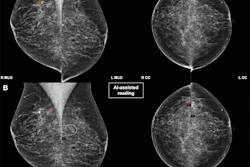
On the AI front, researchers reported success from an AI model based on blind sweep ultrasound data that was used in the U.S. and Africa. They found that the model can accurately estimate gestational age and be generalizable. Another study out of England found that false-negative AI suggestions on mammograms can lead to faltering performance by interpreting breast radiologists.
Finally, the Women’s Imaging MinnieCast continues to roll out new episodes. A few recent ones include featuring Linda Moy, MD, sharing her thoughts on AI and BI-RADS, co-founders of DenseBreast-info.org discussing educating the public on breast density and cancer risk, and experts from American Society for Radiation Oncology (ASTRO) sharing insights on partial breast irradiation for treating cancer.
Be sure to check out the women’s imaging section regularly for the latest news in research, practice, and policy. And visit the AuntMinnie podcast network for new and upcoming episodes of the Women’s Imaging MinnieCast.
Sincerely,
Amerigo Allegretto
Associate Editor
AuntMinnie.com