AI-based risk scoring from screening mammograms over time change and differ between women who do and do not develop breast cancer, suggest findings published June 23 in Radiology.
A team led by Constance Lehman, MD, PhD, from Massachusetts General Hospital and Harvard Medical School in Boston found that risk scores increased among women who developed breast cancer while staying stable among women who were cancer-free.
“For breast radiologists, this suggests that AI-based risk assessment may function as a dynamic imaging biomarker,” Lehman told AuntMinnie. “Just as we monitor changes in imaging findings over time, we may eventually be able to monitor changes in a woman's risk profile over time.”
While AI-based deep learning (DL) models that use imaging data can give individualized five-year breast cancer risk estimates, these models are validated for static risk prediction, Lehman and colleagues noted. The researchers highlighted a lack of data on how scoring may change over time.
The Lehman team studied whether risk scores from a image-based DL model (Mirai, Massachusetts Institute of Technology) change over time and whether trajectories differ between women who do and do not develop breast cancer.
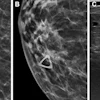
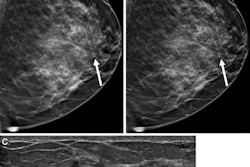
 Images in a 75-year-old woman who underwent routine screening mammography in 2022. Left mediolateral oblique views shown from prior screening mammograms:
(A) 2015, (B) 2018, (C) 2019, and (D) 2021. In (E) 2022, a new mass developed in the left breast at the 6-o’clock position (arrow), with a (F) corresponding irregular
mass at ultrasound (arrow). Subsequent ultrasound-guided core needle biopsy yielded invasive ductal carcinoma, grade 2. The deep learning five-year risk scores gradually increased from 2.0 (2015) to 2.1 (2018), 3.4 (2019), 3.6 (2021), and 15.3 (2022). CMFN = centimeters from nipple, LT = left, TRANS = transverse.RSNA
Final analysis included data from 158,807 screening mammograms from 54,014 women with a median age of 61 years. This included 817 women with cancer and 53,197 cancer-free women.
While the median risk score increased over time for women who developed breast cancer, scoring remained stable for the cancer-free cohort. The researchers observed the same trends in longitudinal models, with findings being consistent across subgroups.
AI risk scores among women with, without breast cancer | ||
Measure | Cancer-free women | Women with cancer |
Median risk score (six years pre-diagnosis) | 1.8 | 2.1 |
Median risk score (index exam) | 2.2 | 6.6 |
Longitudinal modeling slope | 0.09 per year | 1.13 per year |
Lehman said the results open the possibility of using serial mammograms to detect cancer and identify women with increasing risk who may benefit from more personalized screening, supplemental imaging, or preventive strategies.
“We have long relied on mammograms to find cancer,” she told AuntMinnie. “AI is showing us that the mammogram also contains information about future risk, and now we're learning that risk itself can change over time.”
Lehman added that rather than viewing risk as something fixed based on family history, genetics, or a single assessment, AI “may allow us to think about risk as a dynamic process that can be measured directly from imaging.”
Future research will focus on understanding how longitudinal changes in risk scores can be incorporated into clinical decision-making and whether trends over time provide additional information beyond a single risk assessment, Lehman said.
“We are also interested in understanding how dynamic risk assessment can help guide personalized screening strategies, risk-reduction interventions, and earlier identification of women at greatest risk,” she said. “Another important area of future research is determining whether changes in AI-derived risk scores can reflect the impact of risk-reduction interventions.”
The study provides “an important and timely new perspective” on personalized breast cancer screening, according to an accompanying editorial written by Ritse Mann, MD, PhD, from the Radboud University Medical Center in the Netherlands, and Xin Wang, a PhD candidate at the Netherlands Cancer Institute.
“If future studies confirm that such trajectory information can help optimize screening intervals, identify women who may benefit from supplemental imaging, and support more precise risk stratification, then the focus of breast cancer screening may truly begin to shift from single-time-point risk estimation toward trajectory-based precision management,” Mann and Wang wrote.
Read the full study here.