Contrast-enhanced mammography (CEM) performs as well as MRI for diagnosing and staging breast cancer, according to a prospective study, and may serve as a more accessible and affordable alternative to MRI with comparable diagnostic accuracy and performance.
- CEM achieved 100% sensitivity and negative predictive value, matching combined CEM plus digital breast tomosynthesis (DBT) and outperforming MRI
- CEM showed 96.2% overall diagnostic accuracy compared to MRI's 92.4%, with higher specificity and positive predictive value
- Study of 80 women (69 with breast cancer) found no added clinical benefit when CEM was combined with DBT versus CEM alone
- CEM can be performed during initial diagnostic appointment, eliminating need for multiple hospital visits
Contrast-enhanced mammography (CEM) can effectively diagnose and locally stage breast cancer and may sub for breast MRI, according to a prospective study published July 10 in the Journal of Medical Imaging and Radiation Oncology.
CEM showed comparable performance to combined CEM plus digital breast tomosynthesis (DBT) and MRI, wrote a team led by Sarah Savaridas, MD, from the University of Dundee in Scotland. And while the combined method proved to be workable within a one-stop clinic appointment, the researchers observed “no clear benefit” compared to CEM alone.
“Our study supports the use of CEM for the diagnosis and local staging of breast cancer,” the Savaridas team wrote.
Radiology researchers continue to explore how CEM could be an alternative to MRI in breast cancer patients seeking supplemental imaging. CEM proponents say the modality addresses breast MRI’s limitations, including higher costs, lower accessibility, and patient tolerance. Prior research suggests that CEM has comparable performance to MRI.
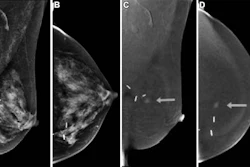
 MRI false positive for additional disease, (top to bottom): A. Index lesion—grade 2 invasive ductal carcinoma; B. MRI lesion two, upper inner quadrant: Stromal sclerosis and columnar cell change; C. MRI lesion three, upper outer quadrant: No ultrasound correlate, no malignancy on follow-up; D. CEM marked background parenchymal enhancement with a unifocal retroareolar lesion demonstrating wash-out on delayed MLO. Images are republished under a Creative Commons license (CC BY 4.0).Wiley Online Library
Emerging technology meanwhile allows DBT and CEM images to be acquired in one breast compression. This combined approach acquires both structural and functional information, though data is limited on whether this leads to significant improvement in diagnosing and staging cancers.
Savaridas and colleagues compared the diagnostic performance and accuracy for local staging of the combined approach compared to digital mammography and MRI.
The study included 80 women, 69 of whom had breast cancer. While the combined approach led to perfect sensitivity and negative predictive value (NPV), CEM alone also achieved the same marks, albeit with slightly higher diagnostic accuracy, specificity, and positive predictive value (PPV). Both approaches outperformed MRI and digital mammography.
Comparison of imaging modalities in diagnosing breast cancer | |||||
Measure | Digital mammography | DBT | MRI | CEM + DBT | CEM |
Sensitivity | 88.4% | 94.2% | 98.5% | 100% | 100% |
Specificity | 80.0% | 60.0% | 54.6% | 60.0% | 70.0% |
PPV | 96.8% | 94.2% | 93.1% | 94.5% | 95.8% |
NPV | 50.0% | 60.0% | 85.7% | 100% | 100% |
Accuracy | 87.3% | 89.9% | 92.4% | 95.0% | 96.2% |
In a subset analysis of 39 women, the researchers compared the respective performances of each imaging approach in identifying additional foci of disease.
In the subset analysis, while MRI achieved perfect sensitivity and NPV, CEM reached perfect specificity and PPV. It was also more accurate than MRI in this area (94.9% vs. 89.7%). Combining CEM with DBT meanwhile did not lead to improvement over CEM alone, achieving an accuracy of 92.3%.
Digital mammography meanwhile showed the lowest performance in diagnostic accuracy and tumor staging.
The study authors also highlighted that CEM can be performed during the initial diagnostic clinic appointment. This eliminates the need for multiple hospital visits to complete diagnostic work-up.
“Acknowledging that this was a small study, we did not demonstrate added clinical value when CEM was combined with DBT,” they added. “However, our results suggest that DBT provides more accurate T-staging than DM in the absence of a contrast technique.”
The authors recommended larger multi-center research to confirm their findings.
Read the full study here.