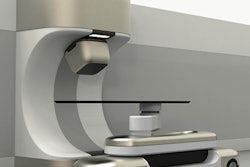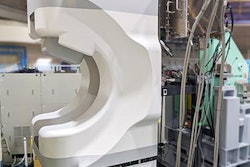
B dot Medical is highlighting the successful performance of a superconducting bending magnet that could be used as part of a compact proton cancer therapy system.
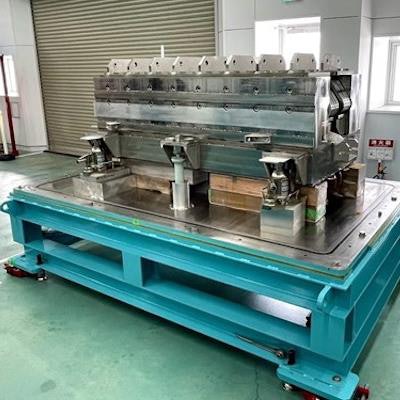
In a cooling and conducting energization test, the magnet generated a high magnetic field, the company said. Its use could make proton cancer therapy systems smaller and less expensive, according to the firm.
 B dot Medical's superconducting magnet. Image courtesy of B dot Medical.
Conventional proton therapy systems are extremely large because they use normal-conducting electromagnets for the gantry, according to the company. This generates a strong magnetic field that bends the proton beam inside the magnet, rotating it around the patient.
But B dot Medical has designed a compact proton therapy system with a nonrotating gantry -- a feat made possible by bending the proton beam.
B dot Medical next plans a pattern operation test to control the magnetic field generated by the superconducting magnet and a proton beam test; it will then apply for Pharmaceutical and Medical Device Act clearance from the U.S. Food and Drug Administration.