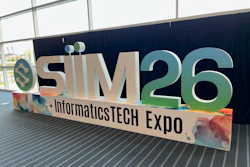
PITTSBURGH -- AI auto-contouring in radiation oncology could save on time per patient, but operational benefits may be capped depending on other factors, according to a presentation given June 12 at the Society for Imaging Informatics in Medicine (SIIM) annual meeting.
In his talk, Rafe McBeth, PhD, from the University of Pennsylvania (Penn) in Philadelphia shared his team’s experience after deployment of a commercial AI auto-contouring system used across a 15-site radiation oncology network.
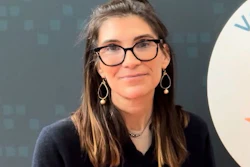
 At SIIM 2026, Rafe McBeth, PhD, shares his team's experience with using a commercial AI system for auto-contouring in radiation oncology.
“It’s been a great experience in deploying AI sort of at scale,” McBeth told AuntMinnie. “To start to use AI to do a process [contouring] that people understand really well … is a great place to start.”
Prior research suggests that AI auto-contouring can make radiation oncology workflows more efficient. However, McBeth, who serves as director of AI at Penn, said these studies have mainly focused on model accuracy rather than operational impact.
His team deployed a commercial AI system for auto-contouring in 2022, with implementation consisting of a three-week clinician onboarding program and integration with treatment planning systems. The researchers also tracked the tool’s use via a customized monitoring dashboard.
McBeth reported that adoption of the AI tool achieved near-universal clinical use (95%). This included AI-generated contours being used in all routine cases.
However, he added that the team observed a plateau in workflow impact. The team analyzed over 4,000 patients and reported Dice scores ranging from 0.80 to 0.85 across “hundreds” of structures.
The use of the AI tool also led to about 15,000 clinical hours returned over a three-year period, about 30 minutes saved per patient for auto-contouring organs at risk. However, this sped up patient arrivals, creating a downstream bottlenecking effect rather than reducing treatment planning time, McBeth said.
Finally, he said that development roadmaps by AI vendors are not entirely aligned with institutional priorities for contouring tumors and targets, which may trigger “build versus buy” conversations on developing AI tools.
McBeth said the biggest lesson learned by the researchers is the need to build AI-native teams. He added that time savings from using AI assistance cannot be “cashed in” because the savings will be needed to build teams for the next round of deployment.
“I think, when looking at purchasing commercial tools, people kind of evaluate it as kind of a cost-benefit [process],” he told AuntMinnie. “And as we get to two, three, four, or 10 models deployed into the clinic, well, now you have a problem that looks a lot closer to your other clinical problems that require the same teams that have been kind of upscaled into AI to provide their perspective.”
McBeth said the team is excited to look at how to scale both commercial and in-house AI tools for clinical deployment and standardize AI use while ensuring quality assurance and safety.
“We need to engage all these people and get their help in making that transition from research to the clinical space,” he added.
Check out AuntMinnie’s full coverage of SIIM 2026 here.