Research conducted at the University of Eastern Finland in Joensuu offers new information on the limitations and applications of transcranial ultrasound therapy, according to a statement released by the university.
The research was presented this month by Aki Pulkkinen, a doctoral candidate, the niversity said. Original findings were published earlier this year in Physics in Medicine and Biology.
Pulkkinen explored two issues that could limit the applicability of transcranial ultrasound: skull-base heating and formation of standing waves.
He found the heating of the skull base during transcranial ultrasound therapy can result in hazardous temperature elevations when the modality is used close to the skull base. He developed three new methods to counteract this potentially hazardous situation. As for standing waves, Pulkkinen also found that the formation of these waves is greatly reduced when specifically designed large-area ultrasound transducers are used (Phys Med Biol, April 2014, Vol. 59:7, pp. 1679-1700).
Finally, the study introduced a model to numerically simulate clinical patient treatments performed with transcranial ultrasound therapy; predictions produced by the model were compared with observations done in previous clinical patient trials, the university said.

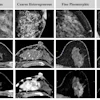



![Examples of ultrasound findings and techniques. (A) Images in a 39-year-old male patient with a mass in the left thigh. The mass is heterogeneous on the B-mode US image (compared with the patient in D) and showed increased microvascularity (superb microvascular imaging [SMI]) and shear-wave elastography (SWE) values. Undifferentiated pleomorphic sarcoma was diagnosed at biopsy (with pleomorphic rhabdomyosarcoma in surgical specimen). (B) Images in an 18-year-old male patient with a mass in the left leg. The mass is hypoechoic on the B-mode image, with no other findings suggestive of malignancy. The lesion is in contact with the cortex of the tibia, which is slightly irregular. CT revealed a doubtful anteromedial tibial erosion. The microvascular study demonstrated high vascularization, suggestive of malignancy. Periosteal Ewing sarcoma was diagnosed with both histologic and immunohistochemical confirmation. (C) Images in a 69-year-old female patient with a lump growing on the outside of the left leg. Multiple SWE examinations were performed (please note the high values obtained in the measurements, whereas the color map highlights the stiffness relative to adjacent tissues). SMI showed areas of increased vascularization to target for sampling. Undifferentiated spindle cell sarcoma was diagnosed at biopsy, with residual leiomyosarcoma in the surgical specimen after neoadjuvant therapy. (D) Images in a 56-year-old female patient with a mass in the right thigh. The mass is heterogeneous at both B-mode ultrasound (similar to patient A) and MRI (coronal T2-weighted spectral attenuated inversion recovery [SPAIR]; T1-weighted pre-contrast and postcontrast imaging), which even shows uptake after the administration of paramagnetic contrast material, which is traditionally suggestive of malignancy. Low values at SMI and elastography are suggestive of benignity. Spindle cell lipoma was diagnosed at biopsy, with atypical spindle cell lipomatous tumor in the surgical specimen.](https://img.auntminnie.com/mindful/smg/workspaces/default/uploads/2026/08/images-radiol250278fig2.APCFLSvX6p.jpg?auto=format%2Ccompress&dpr=2&fit=crop&h=167&q=70&w=250)

