CAPE TOWN - Muscle deterioration in chronic pain is not necessarily a consequence of inactivity but rather follows patterns that emerge in where pain is felt in the body, according to research to be presented on May 12 at the ISMRM meeting.
These results contribute to the "mechanistic understanding of chronic pain conditions," wrote a team led by Merve Kaptan, PhD, of Stanford University in Stanford, CA. Kaptan noted that "this approach may be used to guide rehabilitation decision-making and inform the advancements of precision medicine and person-centered clinical insights."
Chronic pain influences muscle health in both composition and morphometry, the investigators explained, writing that "altered muscle composition and atrophy have been associated with poorer functional outcomes and greater pain persistence, suggesting that muscle health may play a causal role in sustaining chronic pain."
They added that "mechanistic understanding of these changes -- whether they are due to generalized deconditioning, condition-specific factors, or their combination -- remains unclear."
To address this knowledge gap, Kaptan and colleagues tracked localized versus diffuse muscle health patterns manifesting in different chronic pain conditions. They analyzed Dixon fat-water body MRI from 12,176 UK Biobank participants. This cohort included 9,859 pain-free controls, 739 with chronic back pain, 374 with chronic hip pain, 1,110 with chronic knee pain, and 97 with chronic all-over-body pain. Study participants had an average age of 64 years.
The team used a whole-body muscle segmentation and analysis model (MuscleMap Toolbox) to segment 42 muscles across the abdomen, pelvis, and thighs and extract muscle volume and intramuscular fat for each muscle. Overall, it reported the following:
- Chronic pain was associated with higher intramuscular fat and lower muscle volumes, after adjusting for age, height, weight, sex, and imaging site.
- Intramuscular fat and muscle volume changes were condition-specific and corresponded to the location of pain.
- The set of chronic all-over-body pain study participants showed a diffuse, non-localized pattern of increased intramuscular fat and decreased muscle volume.
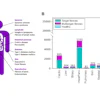
 Analysis Pipeline: 42 bilateral muscles were automatically quantified using the MuscleMap Toolbox. Intramuscular fat and volume for each muscle were used to estimate the trajectories using Hierarchical Bayesian Regression, controlling for covariates. Exemplary individuals showing extreme deviations are displayed in the red-outlined group, underscoring how normative models can be used to identify and interpret variation in muscle health measures at an individual-level.Merve Kaptan, PhD, et al and ISMRM
These findings point to "condition-specific mechanisms over generalized deconditioning" as the cause of chronic pain. These carry implications for rehabilitation and pain management, according to the researchers.
The team suggested that if this is the case, targeted interventions addressing the musculature of the affected region could be more effective than generalized exercise routines.
Check out AuntMinnie.com’s full coverage of ISMRM 2026 on our ShowCast.