A portable MRI system shows promise for increasing imaging access to underserved patient populations -- that is, those in nonhospital settings and rural communities, according to research presented May 9 at the International Society for Magnetic Resonance in Medicine (ISMRM) and the International Society for MR Radiographers & Technologists (ISMRT) meeting in Cape Town, South Africa.
Non-licensed but trained operators at the University of British Columbia (UBC) in Vancouver, Canada, completed nearly 500 brain MRI exams using the Hyperfine Swoop portable ultra-low–field system with no adverse outcomes, ISMRT poster presenter Laura Barlow noted. Barlow is an MRI technologist and an MRI research supervisor at the university.
The results suggest that using portable MRI could address staff shortages, according to Barlow.
"UBC Hyperfine Swoop non-licensed operators safely scanned hundreds of research participants within a controlled framework that complied with local public safety standards," she said, "[which suggests that] this approach can be considered by accreditation entities as a reference."
As the usage of ultra-low–field point-of-care MRI systems increases, professional accreditation entities are seeking to refine clinical staffing requirements, Barlow explained. The experience of research institutions with noncertified but trained operators can be considered evidence for these standards.
Hyperfine Swoop is a low-field (64 milliTesla) portable MRI system designed for point-of-care brain imaging -- with "minimal operator involvement," Barlow noted. Most operators of the device at UBC bring a mix of professional credentials and research experience to the task of imaging patients and have completed an internal training program, but the majority are not registered MRI technologists, she said. She outlined the following required operator training and scope of practice limits:
- Training. Review standard operating practice, Swoop instructions for use, and infection prevention and control guidelines; complete two trainer-observed scanning sessions.
- MRI safety screening. This must be performed by registered MRI technologists for patients' first visits.
- Scope of practice. Only mobile, physically healthy participants can be imaged with the portable MRI device. Operators may not scan a patient alone.
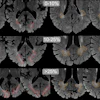
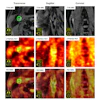
 Hyperfine Swoop acquired examples of pathology detected in patients.Laura Barlow and ISMRT
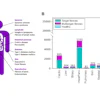
Barlow then reported on an initiative that used Swoop to image 18 patients with multiple sclerosis, 272 members of a depression transcranial magnetic-stimulation treatment cohort, and 192 healthy participants. Of these 482 exams, only two required safety interventions from registered MRI technologist staff; both of these involved entry-level Swoop operators, one of whom attempted to image a wheelchair-dependent participant without assistance, and the other of whom failed to identify an extracranial metal object worn during scanning, she said.
Barlow and colleagues suggest that, as Canadian health institutions and funding agencies evaluate how portable low-field MRI systems might integrate into existing care networks, the real-world experience of research programs like UBC's offers practical evidence for accreditation bodies, noting that "staffing models are changing to address staff shortages, including worker designations in the MRI department."