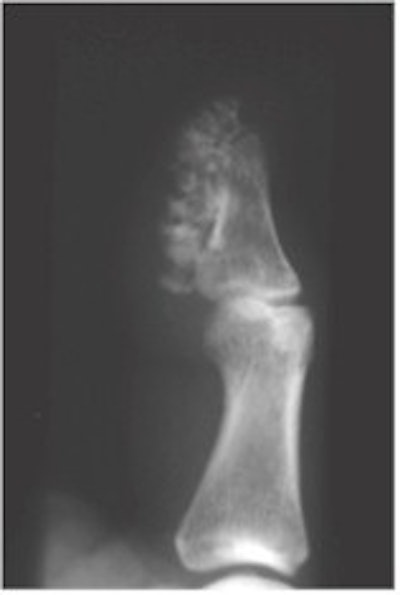
Some painters may think it's harmless to clean high-pressure paint gun tips with a finger, but x-rays have shown that the paint can seep through the skin, resulting in infection, necrosis, and, in worst-case scenarios, amputation.
"We've seen quite a number of people coming into the emergency room with this type of injury," said Dr. Thomas Learch in a presentation at the RSNA meeting last month. Learch is an assistant professor of radiology at the University of Southern California in Los Angeles.
In the past four years, Learch and his co-authors said they have treated 15 men with injuries that typically occur when painters attempt to unclog a spray paint gun using their fingers. Sometimes the injury occurs to professional painters, but the number of non-professional painters -- such as homeowners or college students who are trying to earn money during the summer months -- is on the rise.
In their study sample, these 15 patients presented with high-pressure paint gun injuries with injections of water-based paint involving one finger of the non-dominant hand. The time of injury to presentation ranged from four hours to two weeks. Entrance wounds were punctate to small, in the palmar tuft, resulting in finger-swelling and decreased range of motion.
X-rays demonstrated radiopaque foreign body material in the palmar aspect of the digit, one extending into the palm, and four cases involving the flexor tendon sheath. In some cases, the paint was lodged at the tip, but in others, it had traveled the length of the finger or the arm. The group reported no intraosseous or intraarticular injections.
One patient developed a bone infection and required antibiotic treatment; another man suffered bone death, and the finger was amputated. All the men had some form of permanent injury to their fingers, including loss of range of motion and decreased strength. Postoperative radiographs revealed complete or near-complete removal of foreign body material.
Most often these accidents involve water-based paint because it appears to clog the spray gun more easily than oil-based paints, Learch said.
While the injury doesn't cause pain immediately, within a few hours patients can become uncomfortable, said Dr. Babak Shayestehfar, assistant professor of radiology at Olive View-UCLA Medical Center in Los Angeles. Even then, people may wait days or weeks before seeking treatment.
Learch added that surgery is delayed because primary care doctors are not aware of such injuries. If treatment is sought within 10 hours, the outcome is usually very good, said Shayestehfar, but after that time, complications can occur.
By Edward SusmanAuntMinnie.com contributing writer
December 27, 2000
Click here to post your comments about this story. Please include the headline of the article in your message.
Copyright © 2000 AuntMinnie.com