PHILADELPHIA – Olive oil, aloe vera, and corn starch may be items for the grocery list, but they could also sub for commercial ultrasound gel in a pinch, suggest findings presented May 30 at the American Institute of Ultrasound in Medicine (AIUM) annual meeting.
In his presentation, Keith Barron, MD, from the University of South Carolina in Columbia shared results showing that KY Jelly, aloe vera, and glucomannan (a low-cost commercial starch) could be practical alternatives to ultrasound gel in low-resource settings.
“As ultrasound expands, we have to have gel,” Barron said. “Gel is not always available, so there’s all these case reports on how to make your own gel.”
As ultrasound continues to be mobilized into low-resource areas for expedited care, some of the focus has been on making supplies easier for transport while adhering to quality and safety standards.
Barron noted that commercial ultrasound can be expensive, heavy, and temperature-sensitive, adding that gel can be unavailable in low- and middle-income countries. He also said no studies have systematically evaluated spoilage of alternative ultrasound gels.
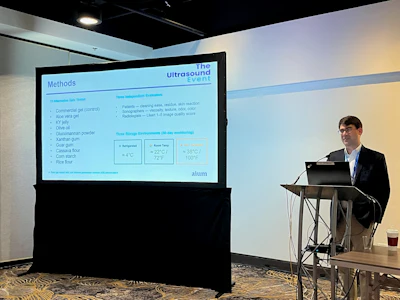
Barron and colleagues tested 10 alternative gels, each made from one of the following goods: commercial gel (control), aloe vera gel, KY Jelly, olive oil, glucomannan powder, xanthan gum, guar gum, cassava flour, corn starch, and rice flour.
For the study, the researchers tested these gels in refrigerated (39°F), room temperature (72°F), and hot (100°F) storage environments. They also gathered survey data from patients being administered the gels during ultrasound scanning, sonographers, and radiologists. The sonographers performed superficial vascular and deep abdominal exams on the patients.
On a five-point Likert scale, the gels achieved an average score of 4.0, with no gel failing image quality.
Barron also reported the following findings:
Only commercial gel, KY Jelly, and glucomannan led to no reactions in any patient while also not having abnormal texture or viscosity, undesirable residue, or being hard to clean.
The commercial gel and KY Jelly performed best by patient comfort, sonographer experience, and radiologist image review while rice flour and cassava flour performed worst.
Commercial gel, KY Jelly, aloe vera, and olive oil lasted over 30 days in all three storage environments.
While xanthan gum, guar gum, and cassava flour gels did not last more than six days in room temperature or hot environments, the addition of potassium sorbate (KS) extended their shelf lives, with the cassava flour gel having the greatest benefit extending by 12 to 30 days.
With these results in mind, Barron said the gel using KY Jelly may be the best overall choice due to this gel’s longer shelf life, wide availability, no preparation needed since this gel is pre-made, and no complaints from patients or sonographers.
He also said aloe vera could be best for field use since this plant is locally growable in tropical and subtropical settings, lowering costs. And the only “minor” complaint from sonographers was directed toward texture.
Finally, Barron said glucomannan gel would be best in areas with refrigeration available while cassava flour plus KS could be good for hotter settings.
“For preparing gels, you should really do it by environment and think about refrigeration,” he said.