Susan G. Komen issued a statement calling for the passing of state and federal legislation in 2024 to remove barriers preventing people from receiving necessary breast care, including imaging.
The organization said that these new laws, which have been or are planned to be introduced this year, are needed to eliminate healthcare inequities and provide people a fair chance in the fight against breast cancer.
Komen is advocating for the following legislation to be passed:
- SCREENS For Cancer Act: This would support state and local programs that provide no-cost breast and cervical exams for people who are uninsured or underinsured through the National Breast and Cervical Cancer Early Detection Program.
- Access to Breast Cancer Diagnosis Act: This would eliminate out-of-pocket costs for people receiving diagnostic and supplemental breast imaging. Eleven states are considering legislation to eliminate the patient cost, and 20 others have already enacted legislation. Komen added that federal action must also be taken.
- Metastatic Breast Cancer Access to Care Act: This would make Social Security Disability Insurance and Medicare benefits available immediately for people with metastatic breast cancer.
- Reducing Hereditary Cancer Act: This would require Medicare to cover testing for some individuals with a known hereditary cancer mutation and those with a personal or family history due to genetics. For those with an inherited gene mutation, Medicare would also cover follow-up testing and imaging and risk-reducing surgeries.
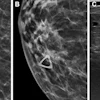
![A normal mammogram confirmed by three-year radiologic follow-up illustrates reader-marked regions of interest (ROIs) during (A) unaided (round 1) and (B) artificial intelligence (AI)–assisted (round 2) reading. Each colored dot represents an ROI for recall by a human reader. Readers could mark more than one ROI per case, represented by multiple dots of the same color. During AI-assisted reading, the AI system displayed three visible prompts: two with suspicion of malignancy scores of 35% (left mediolateral oblique [L MLO] and craniocaudal [L CC]) and one with a suspicion of malignancy score of 10% (right craniocaudal [R CC]), shown as polygonal overlays. Without AI, six of 10 readers (60%) marked a false-positive ROI. With AI assistance, this fell to two of 10 (20%). R MLO = right mediolateral oblique.](https://img.auntminnie.com/mindful/smg/workspaces/default/uploads/2026/07/2026-07-14-radiology-mammogram-ai-auto-bias.H0bYO8QlWs.jpg?auto=format%2Ccompress&fit=crop&h=100&q=70&w=100)


![A normal mammogram confirmed by three-year radiologic follow-up illustrates reader-marked regions of interest (ROIs) during (A) unaided (round 1) and (B) artificial intelligence (AI)–assisted (round 2) reading. Each colored dot represents an ROI for recall by a human reader. Readers could mark more than one ROI per case, represented by multiple dots of the same color. During AI-assisted reading, the AI system displayed three visible prompts: two with suspicion of malignancy scores of 35% (left mediolateral oblique [L MLO] and craniocaudal [L CC]) and one with a suspicion of malignancy score of 10% (right craniocaudal [R CC]), shown as polygonal overlays. Without AI, six of 10 readers (60%) marked a false-positive ROI. With AI assistance, this fell to two of 10 (20%). R MLO = right mediolateral oblique.](https://img.auntminnie.com/mindful/smg/workspaces/default/uploads/2026/07/2026-07-14-radiology-mammogram-ai-auto-bias.H0bYO8QlWs.jpg?auto=format%2Ccompress&fit=crop&h=112&q=70&w=112)