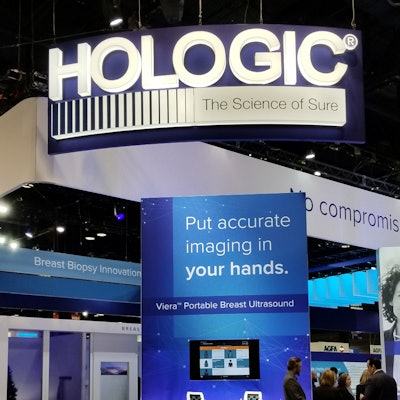
Women's imaging vendor Hologic finished strong in its 2019 fiscal year, with the company's revenue accelerating in the fourth quarter at the highest rate of the year. However, charges related to its Cynosure medical aesthetics business pushed the company into the red for the year.
For the fourth quarter (end-September 28), Hologic finished with revenue of $865.8 million, up 6.4% from sales of $813.5 million in the same period of 2018. The company's net income for the quarter was $39.9 million, which included a noncash impairment charge of $79.2 million. The company's net income was $50.5 million in the fourth quarter of 2018.
Hologic reported that its Breast Health segment turned in revenue of $342.6 million, up 6.3% after currency adjustment from sales of $322.2 million in the fourth quarter of 2018. The company's Diagnostics business reported fourth-quarter revenue of $306.8 million, up 6.2% from sales of $288.9 million in the same period of 2018, which Hologic said represented "robust" growth.
For the year, Hologic recorded revenue of $3.367 billion, compared with $3.218 billion for fiscal 2018. The company posted a loss for the year of $40.2 million, compared with a loss of $111.3 million in 2018. The 2019 numbers include asset impairment charges of $523 million, compared with impairment charges of $731.7 million in fiscal 2018. Both charges were related to write-downs for the company's Cynosure business, a medical aesthetics firm that Hologic bought in 2017.

![A normal mammogram confirmed by three-year radiologic follow-up illustrates reader-marked regions of interest (ROIs) during (A) unaided (round 1) and (B) artificial intelligence (AI)–assisted (round 2) reading. Each colored dot represents an ROI for recall by a human reader. Readers could mark more than one ROI per case, represented by multiple dots of the same color. During AI-assisted reading, the AI system displayed three visible prompts: two with suspicion of malignancy scores of 35% (left mediolateral oblique [L MLO] and craniocaudal [L CC]) and one with a suspicion of malignancy score of 10% (right craniocaudal [R CC]), shown as polygonal overlays. Without AI, six of 10 readers (60%) marked a false-positive ROI. With AI assistance, this fell to two of 10 (20%). R MLO = right mediolateral oblique.](https://img.auntminnie.com/mindful/smg/workspaces/default/uploads/2026/07/2026-07-14-radiology-mammogram-ai-auto-bias.H0bYO8QlWs.jpg?auto=format%2Ccompress&fit=crop&h=100&q=70&w=100)


![A normal mammogram confirmed by three-year radiologic follow-up illustrates reader-marked regions of interest (ROIs) during (A) unaided (round 1) and (B) artificial intelligence (AI)–assisted (round 2) reading. Each colored dot represents an ROI for recall by a human reader. Readers could mark more than one ROI per case, represented by multiple dots of the same color. During AI-assisted reading, the AI system displayed three visible prompts: two with suspicion of malignancy scores of 35% (left mediolateral oblique [L MLO] and craniocaudal [L CC]) and one with a suspicion of malignancy score of 10% (right craniocaudal [R CC]), shown as polygonal overlays. Without AI, six of 10 readers (60%) marked a false-positive ROI. With AI assistance, this fell to two of 10 (20%). R MLO = right mediolateral oblique.](https://img.auntminnie.com/mindful/smg/workspaces/default/uploads/2026/07/2026-07-14-radiology-mammogram-ai-auto-bias.H0bYO8QlWs.jpg?auto=format%2Ccompress&fit=crop&h=112&q=70&w=112)