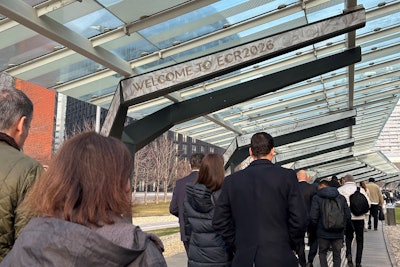
Large language models (LLMs) could help with breast imaging reporting and health literacy, according to a presentation given on March 5 at ECR 2026.
Hemal Grover, MD, from the Icahn School of Medicine at Mt. Sinai in New York, explained current applications of LLMs in breast imaging workflows, including how they could help bridge communication gaps between patients and clinicians.
“This can help equip patients with appropriate healthcare information and can facilitate informed decision-making,” Grover said.
 Hemal Grover, MD.ESR
The jury is out on whether LLMs like ChatGPT or Gemini are more helpful or harmful for patient use and imaging workflows. A Stanford Health Care team in 2025 had results published showing the efficacy of an LLM-based educational tool that could help patients better understand complex imaging terms. Another study published in 2025 showed varied performance among LLMs, with patients getting better answers when they choose LLMs trained in their native language.
Health literacy has come under the spotlight in recent years with the implementation of the Cures Act Final Rule. This requires patients to have real-time access to their radiology reports, though patients may have a tough time understanding the technical language in their reports.
“Sometimes [patients] are looking at their results even before a physician has time to go over their results,” Grover said. “Most literate individuals will then seek healthcare-related information on the internet.”
Grover cited earlier reports suggesting that LLMs helping patients understand their breast imaging reports could help with better adherence to screening, which in turn would help improve mortality and remove perceived barriers. By putting reports into these models and directing them to use layperson terms, radiologists can evaluate and compare the generated response with the original report.
“For us as radiologists, it is very important to understand, are [LLMs] really making reports easier for our patients and how good is their accuracy?” she said.
Grover also cited a 2022 report showing ties between cancer screening adherence and health literacy, saying that higher literacy is an indicator of participation in population-based screening.
However, LLMs currently struggle in assigning BI-RADS categories to imaging findings. Grover cited a 2022 study showing that the models achieved only moderate agreement with radiologists when classifying mammography exams.
Grover and colleagues have been studying the performance of LLMs in actionable breast imaging reports, which include BI-RADS categories 3, 4, and 5. They performed two studies, one featuring breast imaging reports and the other using pathology reports. Using reports copied into ChatGPT 4.0 or Gemini 2.0, the researchers tasked the LLMs with generating readable reports and recommendations for patients.
The researchers showed that both models improved readability compared to the original reports, though with better success for breast imaging reports. Among their measurement methods included the Flesch Reading Ease score – ranging from zero to 100, with higher scores meaning better readability – and the Flesch Kincaid Grade Level.
Readability comparisons between LLMs, original imaging and pathology reports | |||
Measure | Original report | ChatGPT 4.0 | Gemini 2.0 |
Breast imaging reports | |||
| Flesch Reading Ease | 28.6 | 56.3 | 69.4 |
| Flesch Kincaid Grade Level | 12.5 | 8.9 | 6.7 |
Pathology reports | |||
| Flesch Reading Ease | -25.1 | 53 | 47.1 |
| Flesch Kincaid Grade Level | 19 | 9 | 11.2 |
| *All LLM scores achieved statistical significance compared to the original reports. | |||
However, neither model could achieve the ideal Flesch Reading Ease score of 60 or bring reading levels down to a middle-school range when generating recommendations from breast imaging and pathology reports.
Still, Grover said the results show the potential of LLMs in simplifying medical language to patients and help them better understand their imaging reports and the importance of breast cancer screening.
“It [LLMs] is an important tool to improve health literacy and thereby increase patient recruitment and adherence in population-based screening,” she said.
Our full coverage of ECR 2026 can be found here.