
Impaired lung function is independently associated with increased pulmonary perfusion defects identified by a technique called phase-resolved functional lung (PREFUL) MRI, researchers have reported.
Airflow obstruction carries the greatest burden, wrote a team led by Tao Ouyang, MD, PhD, of Capital Medical University in Beijing. The study findings were published June 4 in Radiology: Cardiothoracic Imaging.
“Although current clinical evidence is limited, our study demonstrates that noncontrast, free-breathing PREFUL MRI is a sensitive and noninvasive method for identifying these [lung function] abnormalities,” the group noted.
Chronic respiratory diseases are the third leading cause of death around the world, and in particular chronic obstructive pulmonary disease (COPD) causes more than 3.3 million deaths each year, the researchers explained. They noted that dynamic contrast-enhanced MRI helps track these diseases, but it also imparts radiation and suggested that the PREFUL technique could be used to evaluate pulmonary perfusion, explaining that PREFUL has proven effective in detecting perfusion alterations in a range of conditions and is a noncontrast, radiation-free imaging method that allows for quantitative assessment of pulmonary ventilation and perfusion parameters.
Ouyang and colleagues conducted a study that included 287 patients who underwent spirometry to assess lung function between March 2023 and July 2024. From this test, the group categorized patient lung function as either normal or impaired. Participants also underwent a PREFUL MRI exam for ventilation and perfusion assessment and CT imaging for emphysema evaluation.
The group found that lower predicted percentage of forced expiratory volume in one second (FEV1%), forced vital capacity (FVC), and FEV1/FVC ratio, as well as increased emphysema percentage, were associated with higher pulmonary perfusion defect percentage (QDP), which it wrote suggested that “impaired lung function was associated with increased pulmonary perfusion defects as detected by PREFUL MRI.”
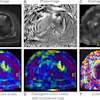
 Caption: Representative images show emphysema and functional lung maps derived by CT and PREFUL-MRI: (A–C) CT-derived emphysema images, (D–F) perfusion maps, (G–I) regional ventilation maps, (J–L) flow-volume loop correlation metric maps, (M–O) ventilation/perfusion combined parameter maps. (A, D, G, J, M) Images in a 63-year-old male with normal spirometry: FEV1%pred = 89.0%, FEV1/FVC = 0.73; emphysema percentage = 0.2%, QDP = 7%, VDPRVent = 2%, VDPFVL-CM = 1%. (B, E, H, K, N) Images in a 65-year-old female with PRISm + RP: FEV1%pred = 71.2%, FVC %pred = 76.8%, FEV1/FVC = 0.76; emphysema percentage = 4.7%, QDP = 10%, VD-PRVent = 18%, VDPFVL-CM = 6%. (C, F, I, L, O) Images in a 57-year-old male with AO: FEV1%pred = 56.8%, FEV1/FVC = 0.52; emphysema = 11.1%, QDP = 31%, VDPRVent = 33%, VDPFVL-CM = 41%. AO = airflow obstruction, FEV1 = forced expiratory volume in 1 second, FVC = forced vital capacity, FVL-CM = flow-volume loop correlation metric, %pred = percent predicted, PREFUL = phase-resolved function lung, PRISm = preserved ratio impaired spirometry, QDP = perfusion defect percentage, RVent = regional ventilation, VDP = ventilation defect percentage.Radiology: Cardiothoracic Imaging
“[Our study showed that] impaired lung function was associated with higher pulmonary perfusion defect percentage and ventilation defect percent,” the authors concluded. “The presence of these defects raises the possibility of exploring earlier use of bronchodilators to improve ventilation or medications that influence pulmonary vascular tone such as nitric oxide–based agents.”
Access the full study here.

.fFmgij6Hin.png?auto=compress%2Cformat&fit=crop&h=100&q=70&w=100)

.fFmgij6Hin.png?auto=compress%2Cformat&fit=crop&h=167&q=70&w=250)


