
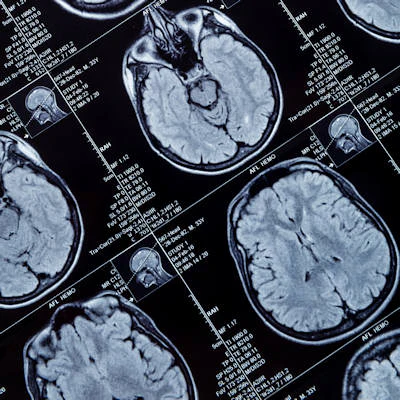
An MRI study of nearly 48,000 people found that different brain disorders like dementia, addiction, and schizophrenia show distinct patterns of accelerated brain aging, which could help doctors diagnose and differentiate these conditions using brain age as a biomarker.
- Predictive age difference (PAD) measures how old a brain appears on MRI compared to a person's actual age, with positive values indicating accelerated aging.
- Dementia showed the highest brain aging effect (Cohen's d = 0.97), followed by addiction (0.84) and psychiatric disorders like schizophrenia (0.53).
- Each disorder showed disorder-specific brain patterns, including the frontotemporal network in psychiatric conditions and fronto-occipital network in dementia.
- The study analyzed structural MRI data from 45,900 healthy controls and 2,698 patients across developmental, addiction, dementia, and psychiatric disorder groups.
Different brain aging patterns could serve as neuroimaging biomarkers for understanding commonly occurring brain disorders, suggest findings published June 20 in PLOS Medicine.
MRI shows that people with dementia, mild cognitive impairment, alcohol addiction, or psychiatric disorders such as schizophrenia show increased brain aging, each in specific patterns within the brain, wrote a team led by Shile Qi, PhD, from the Nanjing University of Aeronautics and Astronautics in China.
“This approach may help to disentangle the pathophysiological complexity of brain disorders from the perspective of brain aging,” the Qi team wrote.
Predictive age difference (PAD) calculates how old the brain is compared to the body. This is the difference between chronological age and the age predicted by brain imaging, where a positive PAD indicates accelerated aging.
Previous studies have shown that brain aging patterns differ across multiple disorders. But comparing these differences within a single framework, as well as identifying the underlying brain imaging and genetic factors, remains limited.
Qi and colleagues compared brain aging across multiple common brain disorders and explored the brain patterns and biological processes underlying these differences.
The researchers used structural MRI data from 45,900 healthy controls and 2,698 patients with one of the following conditions: developmental disorders, addiction, dementia, or other psychiatric disorders. From there, they generated PAD calculations between patients and healthy controls, represented by Cohen’s d effect sizes, using data taken from age, sex, and site.
PAD was consistently greater across disorders, though different brain disorders showed different degrees of abnormality. The team observed the highest effects in cases of dementia, followed by addiction, and then psychiatric disorders. However, developmental disorders fell into an expected PAD range.
PADs between patients, healthy controls | ||
Measure | Cohen’s d effect size | P value |
Alzheimer’s disease | 0.97 | < 0.001 |
Mild cognitive impairment | 0.45 | < 0.001 |
Alcohol and tobacco use disorder | 0.84 | < 0.001 |
Tobacco use disorder | 0.72 | < 0.001 |
Alcohol use disorder | 0.62 | < 0.001 |
Schizophrenia | 0.53 | < 0.001 |
Bipolar disorder | 0.46 | < 0.001 |
Major depressive disorder | 0.28 | < 0.001 |
Autism spectrum disorder | 0.06 | 0.36 |
Attention-deficit/hyperactivity disorder (ADHD) | 0.01 | 0.98 |
The researchers also reported associations between higher PAD values in patient groups to specific spatial brain patterns. These included the frontotemporal network in psychiatric disorders, default mode network-salience network-putamen-thalamus in addiction, and fronto-occipital network in dementia.
“Prefrontal cortex involvement was common across disorders, and disorder-specific brain patterns associated genes were enriched in different biological processes,” the researchers wrote.
The study authors highlighted that genetically informed and spatially specific PAD patterns could be tested in future studies for their usefulness as biomarkers to guide critical clinical decision-making. Examples include transitions between mild cognitive impairment and Alzheimer’s disease, differentiation of schizophrenia and bipolar disorder during the first episode of psychosis, and persistence of ADHD into adulthood.
Read the full study here.

.fFmgij6Hin.png?auto=compress%2Cformat&fit=crop&h=100&q=70&w=100)



.fFmgij6Hin.png?auto=compress%2Cformat&fit=crop&h=167&q=70&w=250)


