

A new MRI technique that visualizes heart tissue and blood flow concurrently allows physicians to identify heart defects in children and plan effective treatment, according to a study published February 12 in Radiology: Cardiothoracic Imaging.
Senior author Matthew Jolley, MD, of Children's Hospital of Philadelphia in Pennsylvania and colleagues developed 3D volume rendering methods for cardiac MRI that display "complex structures within the heart and show how blood moves through them, much like ultrasound images but without the typical challenges of positioning angles," according to an RSNA statement.
"Think of it like adjusting the settings on a photograph to highlight certain features," Jolley said. "We developed specific settings that make heart muscle and heart valves visible while making blood and surrounding tissues transparent."
For cardiac imaging, 3D ultrasound shows tissue and blood flow together, but it has a small field of view, and "the accuracy of flow measurements depends on the angle between the ultrasound beam and the blood flow direction," he explained. CT offers "excellent anatomic images" but doesn't visualize blood flow -- and imparts radiation. MRI can produce high-quality flow images, regardless of angles, and does not expose patients to radiation, which is why using MRI for this indication could be better for children who have to undergo repeated imaging.
The team explained that volume rendering is a computer graphics technique that produces 3D images from MRI scan data, assigning colors and transparency levels to various tissue types based on how they appear in the MRI image. It is useful for tracking blood flow through heart structures such as valve leaflets -- flaps that open to allow blood to flow through, then close to keep the blood from leaking backward in the wrong direction, the group wrote. This MRI technique helps clinicians see the valve leaflets moving and identify exactly where a valve is leaking, and the images generated look similar to those produced by 3D echocardiography with color Doppler, Jolley said.
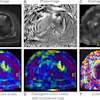
Lead author Julia Iacovella, Jolley, and colleagues tested the method with four children who had complex heart conditions present from birth. They highlighted in particular one patient, a 4-year-old boy with a leaking and narrowed aortic valve who was being evaluated for valve repair or replacement surgery, reporting that the MRI technique showed the valve leaflets and a central jet of leakage -- which helped guide the surgeons' approach.
The researchers see the MRI visualization method as a complement to ultrasound rather than a replacement, according to Jolley.
"The quality of these visualizations depends heavily on the quality of the underlying MRI scan," he said. "Approaches like manual tracing can correct for image imperfections and is still necessary for certain analyses like computer simulations of heart function."
A suite of free cardiac image processing tools called SlicerHeart is available for research and treatment in cardiovascular medicine at SlicerHeart.org, the authors noted.
Access the full study here.


.fFmgij6Hin.png?auto=compress%2Cformat&fit=crop&h=100&q=70&w=100)



.fFmgij6Hin.png?auto=compress%2Cformat&fit=crop&h=167&q=70&w=250)


