

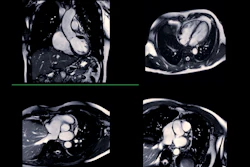
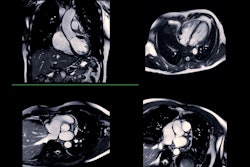
Cardiac MRI can identify late gadolinium enhancement (LGE) in Takotsubo syndrome patients, according to a study published February 25 in the American Journal of Roentgenology.
In fact, a group led by Riccardo Cau, MD, of Cagliari University Hospital in Monserrato, Italy, reported that the presence of LGE was independently linked to earlier imaging after symptom onset and greater myocardial edema extent.
"[Our] results may provide useful context when radiologists encounter LGE on cardiac MRI in patients with [Takotsubo syndrome]," the group noted.
Takotsubo syndrome is an acute but reversible form of myocardial dysfunction characterized by distinctive left ventricular wall motion abnormalities and transient myocardial tissue changes, typically triggered by physical or emotional stress, the authors explained. Although cardiac MR imaging is considered the gold standard test for evaluating cardiac morphology, function, and tissue characterization in Takotsubo syndrome -- and LGE is a key prognostic cardiac MRI parameter for various cardiovascular diseases -- the significance of LGE in Takotsubo syndrome continues to be debated.
The group conducted a study to evaluate the frequency of LGE, identify factors associated with its presence, and assess its prognostic implications. The study included 370 patients with Takotsubo syndrome who underwent cardiac MRI between November 2007 and December 2024. Patient data came from the EVOLUTION (Exploring the eVolution in prognOstic capabiLity of mUlti-sequence cardiac magneTIc resOnance in patieNts affected by Takotsubo cardiomyopathy) registry, which consisted of patients admitted to the hospital for Takotsubo syndrome who had a cardiac MRI exam within 10 days of symptom onset.
Two radiologists reviewed LGE images to assess exams for the visual presence of the phenomenon; a third radiologist quantified LGE extent both visually and using semiautomated AI methods.
The researchers reported the following:
- Based on the consensus findings of the two radiologists, LGE was present in 58 (15.7%) patients.
- In multivariable analysis, LGE presence was independently associated with a shorter interval from presentation to cardiac MRI (OR per day, 0.81; p = 0.003) and a greater extent of myocardial edema on T2-weighted STIR images (OR per segment, 1.44; p < 0.001).
- The mean LGE extent by visual assessment was 25.5%.
- In-hospital adverse events occurred in 88 (23.8%) patients but were not significantly associated with LGE presence (p = 0.44).
The results suggest that patients imaged early after symptom onset are more likely to demonstrate LGE, consistent with the transient nature of myocardial tissue changes in Takotsubo syndrome, the authors noted.
"LGE showed significant independent associations with greater myocardial edema extent and earlier timing of MRI after clinical presentation but was not associated with in-hospital adverse events," they concluded.
Access the full study here.
.fFmgij6Hin.png?auto=compress%2Cformat&fit=crop&h=100&q=70&w=100)


.fFmgij6Hin.png?auto=compress%2Cformat&fit=crop&h=167&q=70&w=250)


