Artificial intelligence (AI) firm ClariPi has received 510(k) clearance from the U.S. Food and Drug Administration (FDA) for its AI-based CT denoising technology.
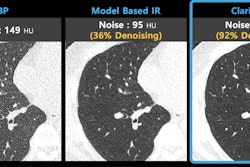
The company unveiled ClariCT.AI at RSNA 2018, showing that it uses a deep convolutional neural network trained with more than 1 million patient images to work in a vendor-neutral way to reduce noise and enhance image clarity for low-dose and ultra-low-dose DICOM CT images. The Clarity Engine is designed to separate image noise selectively while enhancing underlying structures, thus providing clarity-restored images.
ClariPi said the AI-based denoising technology potentially could enhance radiologists' reading confidence and enable accurate analysis for various imaging applications, including low-dose lung cancer screening CT.







![Images show the pectoralis muscles of a healthy male individual who never smoked (age, 66 years; height, 178 cm; body mass index [BMI, calculated as weight in kilograms divided by height in meters squared], 28.4; number of cigarette pack-years, 0; forced expiratory volume in 1 second [FEV1], 97.6% predicted; FEV1: forced vital capacity [FVC] ratio, 0.71; pectoralis muscle area [PMA], 59.4 cm2; pectoralis muscle volume [PMV], 764 cm3) and a male individual with a smoking history and chronic obstructive pulmonary disorder (COPD) (age, 66 years; height, 178 cm; BMI, 27.5; number of cigarette pack-years, 43.2, FEV1, 48% predicted; FEV1:FVC, 0.56; PMA, 35 cm2; PMV, 480.8 cm3) from the Canadian Cohort Obstructive Lung Disease (i.e., CanCOLD) study. The CT image is shown in the axial plane. The PMV is automatically extracted using the developed deep learning model and overlayed onto the lungs for visual clarity.](https://img.auntminnie.com/mindful/smg/workspaces/default/uploads/2026/03/genkin.25LqljVF0y.jpg?auto=format%2Ccompress&crop=focalpoint&fit=crop&h=112&q=70&w=112)

