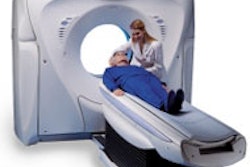
A new 16-slice CT scanner optimized for cardiac imaging will be a featured product in Toshiba’s booth. The new system, called Aquilion 16 CFX, was introduced in August and features 0.4-second scanning and Toshiba’s new cardiac function analysis software, SureCardio.

Also making its RSNA debut is Aquilion 8, an eight-slice version of Toshiba’s flagship Aquilion line. The scanner is upgradable to a 16-slice configuration, has a 7.5-MHU MegaCool tube, and 0.4-second gantry rotation available as an option. Aquilion 8 employs a 40-row Quantum detector with 32 mm of total detector coverage per rotation, and slice acquisition modes ranging from 8 x 0.5 mm to 8 x 4 mm.
The scanner also uses a helical cone-beam reconstruction technique that allows for image reconstruction of up to six images per second. Flat-panel displays are standard on the scanner, according to Toshiba.
Other new additions to the Aquilion line are Aquilion Super 4 and Aquilion Super 4 FX, four-slice scanners with 0.4-second gantry rotations. The models feature 7.5-MHU MegaCool tubes, 34-row Quantum detectors, and multislice acquisition modes ranging from 4 x 0.5 mm to 4 x 8 mm.
The Super 4 version has 0.4-second scanning as an option, while 0.4-second imaging comes standard on the Super 4 FX model. Both of the Super 4 models feature a patient couch with a 1.8-meter scan range, compared to a 1.4-m scan range on Toshiba’s previous four-slice Aquilion model.