A newly developed carbonic anhydrase IX (CAIX)-targeted PET tracer has demonstrated that it can detect clear cell renal cell carcinoma (ccRCC), according to early phase clinical results presented June 1 at the 2026 Society of Nuclear Medicine and Molecular Imaging (SNMMI) annual meeting in Los Angeles.
The gallium 68-labeled molecular probe, a peptide-based tracer named 68Ga-RCC78, successfully identified additional metastatic lesions missed by standard imaging while significantly reducing abdominal background noise, noted a group led by Prof. Dawei Jiang from Huazhong University of Science and Technology and Tongji Medical College in Wuhan, China.
“This research provides a more precise ‘molecular map’ for kidney cancer,” stated Jiang for the SNMMI. “Our new probe, 68Ga-RCC78, strikes a vital balance by minimizing background noise in the abdominal cavity while maintaining the highest possible uptake in tumors, and hopefully representing a significant step toward personalized radiotheranostics in ccRCC.”
ccRCC is characterized by a unique, constitutive overexpression of CAIX, making it an attractive target for molecular imaging, according to Jiang and colleagues. Developing effective CAIX-targeted radiopharmaceuticals has been historically challenging because the physiological expression of CAIX in the gastrointestinal tract often creates high background interference, obscuring abdominal metastases, they noted.
To fill the gap, the group developed radiotracers from synthesizing 16 novel CAIX-specific cyclic peptides, radiolabeling them with Ga-68. Researchers conducted cellular uptake studies in CAIX-high and CAIX-low cell lines, as well as CAIX-blocked controls.
Preclinical assessment included PET/CT imaging, biodistribution, and immunohistochemistry (IHC) in ccRCC xenografts and patient-derived xenograft (PDX) models. The tracer with the best performance in mice studies was then evaluated in a first-in-human study that included 13 ccRCC patients.
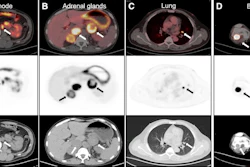
 A 68Ga-RCC78 PET scan (C) of a patient four years post-radical right nephrectomy. During follow-up, new nodules were detected in the left adrenal gland and kidney. CAIX-targeted scan clearly visualized metastatic lesions in the mediastinum, pancreas, adrenal gland, and kidney (SUVmax > 30), demonstrating the tracer's ability to maintain high tumor uptake despite significantly reduced abdominal background.Prof. Dawei Jiang and SNMMI
Jiang and colleagues say 68Ga-RCC78 is promising for clinical translation, as few effective theragnostic options are available for advanced or metastatic ccRCC.
According to the results, tumor accumulation in mice reached a maximum standardized uptake value (SUVmax) of 4.65 at two hours post-injection, yielding a tumor-to-background ratio (TBR) of 41.3, according to the results. Normal tissue uptake was minimal, with gastrointestinal background uptake recorded at only 0.17, the researchers noted.
Patients with pathologically confirmed ccRCC then underwent PET/CT exploiting one of the developed tracers. Researchers observed that 68Ga-RCC78 accurately distinguished CAIX-positive tumors (n = 12) from CAIX-negative cases (n = 4), consistent with biopsy immunostaining.
For CAIX-positive cases, primary and metastatic tumor uptake markedly exceeded that of F-18 FDG (SUVmax 26.2 versus 4.1), while low intestinal activity (SUVmax 12) enabled clear visualization of intra-abdominal and metastatic lesions, according to the results.
In addition, 68Ga-RCC78 achieved a superior TBR in ccRCC patients (24.6 versus 4), enabling the detection of additional tumor lesions (58 versus 50), the group reported.
"Combining high tumor specificity with low physiological background, its robust preclinical and early clinical performance supports further clinical investigation as a diagnostic tool and potential therapeutic agent for ccRCC patient management," Jiang and colleagues concluded.
“We have not only developed a diagnostic tool but also hope to provide a blueprint for treatment," Jiang told the SNMMI, adding that the molecule is being labeled with therapeutic isotopes to deliver targeted radiation directly to cancer cells.
Check out AuntMinnie’s full coverage of SNMMI 2026 on our ShowCast.