Fibroblast activation protein inhibitor (FAPI)-PET/CT performed just 10 minutes after injection shows equivalent performance to standard 60-minute scans in patients being staged for suspected lung cancer, according to a recent study.
The finding comes from a post-hoc analysis of 30 patients referred for initial lung cancer staging at Bologna University Hospital in Italy who underwent gallium-68 (Ga-68) FAPI-46 PET/CT and has potential implications in improving workflow efficiency, reported Morten Bentestuen, MD, of Aalborg University Hospital in Denmark, and colleagues.
“Early FAPI-PET/CT imaging offers more efficient and streamlined imaging of lung cancer patients without compromising diagnostic performance,” the group wrote. The research was presented June 2 at the Society of Nuclear Medicine and Molecular Imaging (SNMMI) annual meeting in Los Angeles.
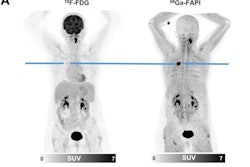
By convention, most molecular imaging tracers such as F-18 FDG are injected one hour prior to PET scans to allow time for uptake of the tracer by tumors. FAPI-PET has proven more accurate than F-18 FDG-PET due to higher uptake of the radiotracer by tumors, yet whether this improved accuracy can translate to shorter scan times in lung cancer patients has not been explored, according to the researchers.
To that end, the investigators analyzed imaging from 30 participants (mean age 69 years old; 15 women; 19 adenocarcinomas) who underwent both gallium-46 (Ga-46) FAPI-46 PET/CT at both 10 minutes (FAPI10) and 60 minutes (FAPI60). Patients had previous doubtful or inconclusive findings on FDG-PET/CT. The scans were interpreted separately by at least two physicians, with discrepancies resolved by consensus. Staging agreement was assessed against international standards, and diagnostic performance was evaluated against histopathology, where available.
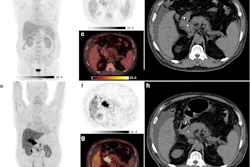
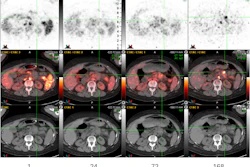
 PET/CT images performed at 10- and 60-minutes following injection of Ga-68 FAPI-46 (mean 181 MBq; range 143–225 MBq). Morten Bentestuen, MD, and SNMMI
According to the results, across 30 primary tumors and 555 lymph node stations, agreement between FAPI10 and FAPI60 was near perfect (Cohen’s kappa = 0.89 for primary tumors and ICC = 0.98 for lymph node stations). Furthermore, the scans were equivalent for the evaluation of distant metastases (10 lesions) and showed perfect agreement for overall staging, the researchers reported.
Using histopathology as the reference standard, lymph node evaluation across 76 stations showed a sensitivity and specificity of 100% (5/5 and 71/71, respectively). Meanwhile, standard uptake values for malignant lesions remained stable across timepoints, while background uptake declined, resulting in higher tumor-to-background ratios at FAPI60 (p<0.05).
“For primary staging of suspected lung cancer, FAPI-PET at 10 minutes post-injection demonstrated equivalent staging and diagnostic performance to 60 minutes, though delayed imaging provided slightly improved image quality and fewer incidental findings,” the group wrote.
Early imaging did reveal potential pitfalls, the researchers noted, such as interstitial lung disease and incidental pancreatic uptake, whereas later, repeated imaging provided additional insights, although these findings did not affect overall interpretation.
“Delayed, repeated imaging provides additional information and is appropriate in certain cases of incidental or uncertain findings,” the group concluded.
Check out AuntMinnie’s full coverage of SNMMI 2026 on our ShowCast.