Imaging services provider RadNet will launch a mammography screening clinic December 8 at the Walmart Supercenter in Milford, Delaware.
The launch is the first installation of RadNet’s new “MammogramNow” program, which aims to enhance breast health awareness and accessibility and includes the integration of AI mammography screening software, according to the company.
“We believe RadNet currently performs close to five percent of all mammograms in the United States annually, and the pilot with Walmart is designed to provide even greater, convenient access for women,” said RadNet president and chief executive officer Howard Berger, MD, in a statement released by the firm.
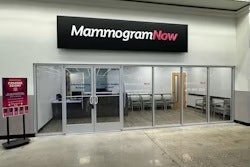
RadNet's new mammography screening clinic at the Walmart Supercenter in Milford, DE. Image courtesy of RadNet.
The MammogramNow clinics will deploy AI technology for mammography screening and interpreting mammograms developed by DeepHealth AI, a software firm RadNet acquired in 2020.
In addition, the MammogramNow program will offer women access to RadNet’s Enhanced Breast Cancer Detection service, which works in tandem with a woman's annual breast screening regimen and enables patients to access the following tools:
- Use of DeepHealth's FDA-cleared Saige-Density mammography breast density assessment software
- An AI-driven review applied to suspicious exams and findings
As part of the pilot, RadNet will actively promote breast health education and awareness initiatives, providing the Milford community with information about breast health and the need for regular screenings, the company said.

![A normal mammogram confirmed by three-year radiologic follow-up illustrates reader-marked regions of interest (ROIs) during (A) unaided (round 1) and (B) artificial intelligence (AI)–assisted (round 2) reading. Each colored dot represents an ROI for recall by a human reader. Readers could mark more than one ROI per case, represented by multiple dots of the same color. During AI-assisted reading, the AI system displayed three visible prompts: two with suspicion of malignancy scores of 35% (left mediolateral oblique [L MLO] and craniocaudal [L CC]) and one with a suspicion of malignancy score of 10% (right craniocaudal [R CC]), shown as polygonal overlays. Without AI, six of 10 readers (60%) marked a false-positive ROI. With AI assistance, this fell to two of 10 (20%). R MLO = right mediolateral oblique.](https://img.auntminnie.com/mindful/smg/workspaces/default/uploads/2026/07/2026-07-14-radiology-mammogram-ai-auto-bias.H0bYO8QlWs.jpg?auto=format%2Ccompress&fit=crop&h=100&q=70&w=100)


![A normal mammogram confirmed by three-year radiologic follow-up illustrates reader-marked regions of interest (ROIs) during (A) unaided (round 1) and (B) artificial intelligence (AI)–assisted (round 2) reading. Each colored dot represents an ROI for recall by a human reader. Readers could mark more than one ROI per case, represented by multiple dots of the same color. During AI-assisted reading, the AI system displayed three visible prompts: two with suspicion of malignancy scores of 35% (left mediolateral oblique [L MLO] and craniocaudal [L CC]) and one with a suspicion of malignancy score of 10% (right craniocaudal [R CC]), shown as polygonal overlays. Without AI, six of 10 readers (60%) marked a false-positive ROI. With AI assistance, this fell to two of 10 (20%). R MLO = right mediolateral oblique.](https://img.auntminnie.com/mindful/smg/workspaces/default/uploads/2026/07/2026-07-14-radiology-mammogram-ai-auto-bias.H0bYO8QlWs.jpg?auto=format%2Ccompress&fit=crop&h=112&q=70&w=112)