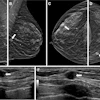
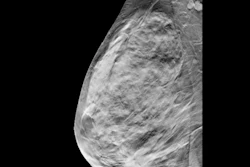
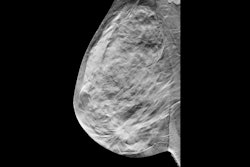
A deep learning model using longitudinal digital breast tomosynthesis (DBT) exams outperformed digital mammography and clinical risk models in predicting five-year breast cancer risk, potentially supporting more personalized and dynamic screening strategies for women.
- The DBT-based deep learning model achieved an area under the curve of 0.72 for five-year risk prediction in independent testing, outperforming single-timepoint DBT (0.71) and digital mammography models (0.69)
- The model uses longitudinal exams, patient age, and breast density to estimate cancer risk, capturing evolving imaging patterns over time
- For women with extremely dense breasts, the model classified 39.7% as average risk with 0.8% observed five-year cancer incidence
- Enhanced volumetric detail and detection of changes in breast density and texture over time provide predictive advantages over single-timepoint imaging
Digital breast tomosynthesis (DBT) could help improve long-term breast cancer risk prediction, according to research published August 12 in the American Journal of Roentgenology.
A deep-learning model that uses longitudinal DBT exams outperformed digital mammography-based models and clinical risk models in predicting long-term breast cancer risk, wrote a team led by Yiqiu Shen, PhD, from NYU Langone Health in New York.
“Longitudinal DBT-based risk prediction has the potential to inform dynamic risk assessment using screening images and to support future personalized screening strategies,” the Shen team wrote.
AI models have relied on data from conventional mammographic data. While DBT use continues to rise in the U.S. and may yield more benefits over full-field digital mammography, its potential to predict long-term cancer risk remains unexplored, the researchers noted.
Shen and colleagues added to the literature by developing and testing their own deep-learning DBT model to predict cancer risk. The study included 313,335 DBT exams collected between 2016 and 2020 from 161,077 women with an average age of 58.5 years. The team’s DBT-based risk-prediction model estimated two- to five-year breast cancer risk using longitudinal exams, patient age, and breast density. The team evaluated the model in an independent test set (n = 34,570 exams) and a matched case-control cohort (n = 432 exams).
For the study, the researchers compared the algorithm's performance to those of a single-timepoint DBT model, the Mirai model using same-day full-field digital mammograms, and the Tyrer-Cuzick model.
The team’s DBT model outperformed the single-timepoint DBT model and Mirai for predicting five-year breast cancer risk in the independent test set. It also outperformed the Tyrer-Cuzick model in the matched case-control cohort.
Comparison of breast cancer risk prediction models for five-year risk | |
Model | Area under the curve (AUC) |
Independent test set |
|
DBT-based risk prediction | 0.72 |
Single-timepoint DBT-based risk prediction | 0.71 |
Mirai | 0.69 |
Matched case-control cohort |
|
DBT-based risk prediction | 0.68 |
Tyrer-Cuzick | 0.56 |
*All comparisons achieved statistical significance.
The researchers also evaluated their DBT model’s performance for women with extremely dense breasts (n = 1,877). The model classified 39.7% of women as average risk, with an observed five-year cancer incidence of 0.8%.
Finally, among exams of women with fatty breasts (n = 2,605), the model classified 14.8% as high risk, with an observed five-year cancer incidence of 2.6%.
The study authors suggested the DBT model’s improved performance over the digital mammography model “may reflect enhanced volumetric detail” captured by DBT.
“In addition, evaluating multiple examinations over time captures evolving imaging patterns,” they wrote. “Changes in breast density and texture could reflect shifts in hormones, environment, and lifestyle and may provide predictive information beyond that available from single-timepoint models.”
The authors also called for future studies to externally validate the model across diverse institutions and vendors. They also wrote that these studies can also evaluate the model’s integration for a wider range of risk factors, as well as prospectively evaluate DBT-based risk prediction in personalized breast cancer screening strategies.
Read the full study here.