CEM-guided biopsy is an effective and safe procedure for sampling suspicious enhancing breast findings, with a 28% malignancy detection rate in a study of 53 biopsies. This technique offers a cost-effective alternative to breast MRI with better accessibility and shorter acquisition times.
- 28% malignancy yield: CEM-guided biopsy detected cancer in 15 of 53 cases, with an additional 4 high-risk pathologies identified
- Safe procedure: Only 2 post-biopsy hematomas occurred (neither requiring intervention) among all 53 biopsies performed
- MRI alternative: CEM offers comparable cancer detection to breast MRI while being more cost-effective and accessible
- No predictive variables: Researchers found no statistically significant imaging features that predicted malignancy outcomes
- Diverse lesion types: Study evaluated 36 non-mass enhancements, 14 masses, 2 asymmetries, and 1 architectural distortion
Contrast-enhanced mammography (CEM)-guided biopsy is effective for sampling suspicious enhancing breast findings, according to research published October 15 in Clinical Imaging.
CEM-guided biopsy found malignancy in about one out of four cases in a single institution study led by Michelle Lee, MD, and colleagues from the Memorial Sloan Kettering Cancer Center in New York.
“Assessing the imaging characteristics and malignancy yield is crucial for optimizing both diagnostic accuracy and procedural efficiency as CEM and CEM-guided biopsy continues to expand in clinical practice,” Lee et al wrote.
Prior research has reported CEM being comparable to breast MRI for cancer detection. Proponents say CEM could be a suitable alternative to MRI due to its cost-effectiveness, potential for better accessibility, acquisition time, patient preference, and use in cases where patients cannot undergo an MRI scan.
And while emerging research suggests that CEM can be successfully used in breast biopsy, little data exist on its clinical utility.
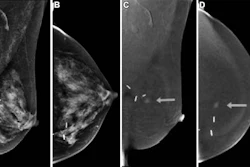
The Lee team described its experience in using CEM-guided breast biopsy, evaluating imaging features and predictors of malignancy. The team included 53 CEM-guided biopsies performed in 2023 and 2024 in the study. The women had had an average age of 50 years, with an age range of 34 to 87 years.
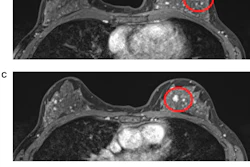
The researchers reported a median biopsy target size of 1.2 cm, with a range of 0.4 to 9.3 cm. They also found the following biopsy targets: 36 non-mass enhancements, 14 masses, two asymmetries, and one architectural distortion.
Of the biopsied targets, 15 yielded malignancy, four yielded high-risk pathology, and 34 had benign pathology. On excision, one high-risk lesion and one benign discordant biopsy site yielded malignancy.
Among other findings, two women had post-biopsy hematomas (none needing intervention), and researchers found no statistically significant predictors of malignancy. And variables like target presentation, breast cancer status, and breast density did not show significant ties to malignancy.
The malignancy yield in the study could provide clinically useful context when counseling patients recommended for CEM-guided biopsy, the study authors wrote. They added that more studies are needed in larger patient populations.
“Our findings support CEM-guided biopsy is safe and efficacious for obtaining tissue diagnoses from suspicious enhancing lesions without a sonographic correlate,” the authors wrote.
Read the full study here.