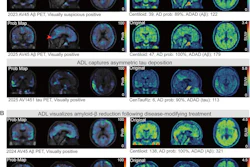
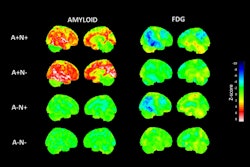
A relatively new tau PET imaging agent identifies significantly more individuals with tau pathology across the Alzheimer's disease spectrum than F-18 flortaucipir, the FDA-approved agent, according to a study published May 30 in The Lancet.
The findings have "direct implications for patient stratification in clinical trials and more precise guidance for therapeutic decision-making," wrote a team led by Guilherme Povala, PhD, of the University of Pittsburgh.
"Compared with F-18 flortaucipir, [the investigational tracer F-18 MK6240] identified more individuals with tau pathology in [those both] cognitively unimpaired and cognitively impaired," the group explained.
Tau PET imaging provides a key biomarker for Alzheimer's disease, informing diagnosis, staging, and therapeutic selection, the investigators noted, writing that "tau PET tracer selection influences the frequency of detection of tau pathology across the ageing and Alzheimer's disease spectrum."
Povala and colleagues conducted a study that compared performance of F-18 flortaucipir to that of F-18 MK6240, an agent that "potentially exhibits higher sensitivity for neurofibrillary tangles and superior signal-to-noise ratio." The research included 682 patients recruited from eight north American sites who underwent PET, amyloid-β (Aβ) PET, and cognitive assessments between March 2022 and August 2025. The team tracked each tracer's accuracy for identifying Alzheimer's disease-related cognitive impairment and incidence of tau positivity in early medial temporal lobe (MTL) and late neocortical regions of participants' brains. Most patients identified as white (93%) and most were between the ages of 65 and 89 (63%).
Overall, the investigators reported that F-18 MK6240 was more accurate than F-18 flortaucipir for distinguishing Alzheimer's disease from non-Alzheimer's disease impairment, with an area under the curve (AUC) of 0.93 compared to 0.86, respectively (p < 0.0001).
They also found the following:
- Among older adults, tau positivity status agreed between the two agents in 87% of patients for medial temporal lobe and in 94% for neocortical regions.
- In cognitively unimpaired participants, F-18 MK6240 flagged twice as many medial temporal lobe-positive cases as F-18 flortaucipir (n=54 versus n=23, respectively).
- The prevalence ratio for F-18 MK6240 in Aβ-positive patients was 2.43 (p = 0.0003), identifying 23 additional cases per 100.
- Among 84 discordant cases between the two tracers, 89% were positive only on F-18 MK6240 and had higher Aβ burden (p < 0.0001), APOEε4 gene frequency (p < 0.0001), and cognitive impairment (p = 0.0043) than those negative on both agents.
- Neocortical tau positivity was identified more frequently with F-18 MK6240 than with F-18 flortaucipir in cognitively impaired individuals (28% versus 16%).
- The prevalence ratio in Aβ-positive findings from F-18 MK6240 imaging was 1.74 (p < 0.0001), which identified 15 additional mild cognitive impairment and 21 dementia cases per 100.
Compared with F-18 flortaucipir, F-18 MK6240 identified "twice as many cognitively unimpaired Aβ-positive individuals with early medial temporal tau accumulation and more cognitively impaired Aβ-positive participants with neocortical tau involvement" -- flagging positivity at lower Aβ burden and detecting tau pathology earlier in the disease continuum, Povala and colleagues wrote.
"These results suggest that current estimates of tau PET positivity might be substantially underestimated, potentially delaying recognition of tau pathology and limiting access to disease-modifying therapies informed by tau PET," they concluded. "Tracer selection should be considered a critical determinant in Alzheimer’s disease care pathways, regulatory frameworks, and global efforts to advance early detection, equitable access, and precision medicine in neurodegenerative disease."
Click here to access the full study.