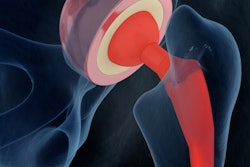
Computer software and artificial intelligence (AI) company RSIP Vision has launched a metal implant and anatomical CT segmentation module for orthopedic applications.
The software module helps users plan revision arthroplasty and other orthopedic procedures in patients with metal implants, according to the firm, and it can segment joints from CT scans of hips, knees, shoulders, and spines. It has already been used for applications such as periprosthetic fractures around implants or fusions, recurring tumors near implants, and repeat femoral neck fractures after fusion, RSIP Vision said.
The company plans to make the software available through CT vendors and medical device vendors, it said.








![Axial images from unenhanced calcium score cardiac CT (left) and curved planar reformation images from CT angiography (right) show that higher long-term exposure to air pollution is associated with greater coronary artery calcium and more obstructive coronary artery disease (CAD). Top row: Images in a 68-year-old male patient with higher 10-year mean ambient air pollution exposure (7.9 μg/m3 for particulate matter measuring ≤2.5 μm in diameter [PM2.5] and 17.4 parts per billion [ppb] for NO2) with extensive CAD (coronary artery calcium score [CACS] >1,000 and obstructive CAD [≥70% diameter stenosis]). Bottom row: Images in a 57-year-old female patient with lower 10-year mean ambient air pollution exposure (6.3 μg/m3 for PM2.5 and 4.6 ppb for NO2) with no CAD (CACS = 0 and no obstructive stenosis).](https://img.auntminnie.com/mindful/smg/workspaces/default/uploads/2026/06/hanneman.r6SMLzkezo.png?auto=format%2Ccompress&fit=crop&h=112&q=70&w=112)


