Tuesday, November 30 | 10:40 a.m.-10:50 a.m.| SSG03-02 | Room S504AB
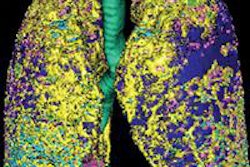
If individualized medicine is the new mantra, emphysema evaluation is one of its most promising potential applications. Radiologists from National Jewish Health in Denver compared quantitative CT measurements of emphysema to physiologic measures of disease severity.Quantitative CT has the potential to quantify emphysema and air trapping as distinct components of chronic obstructive pulmonary disease (COPD), which may be important for phenotyping the disease and devising individualized treatment approaches, said radiologist and lead researcher Joyce Schroeder, MD.
Schroeder and colleagues performed a quantitative CT analysis on 1,759 subjects (ranging from controls through GOLD stage IV) in the COPDGene Study. The subjects underwent volumetric CT both at full inspiration and at the end of normal expiration. The analysis software defined lung voxels as 950 HU or less (inspiratory) as emphysema and voxels as 856 HU or less (expiratory) as air trapping.
Quantitative CT was strongly associated with spirometric impairment in cigarette smokers, Schroeder said. In particular, the extent of air trapping, along with clinical parameters, correlated strongly with physiologic measurements of airway obstruction.