Look for this Tustin, CA, company to highlight advances to its 64-slice Aquilion platform, such as a new high-speed data transfer platform, as well as a wide-bore scanner designed for radiation therapy planning applications.
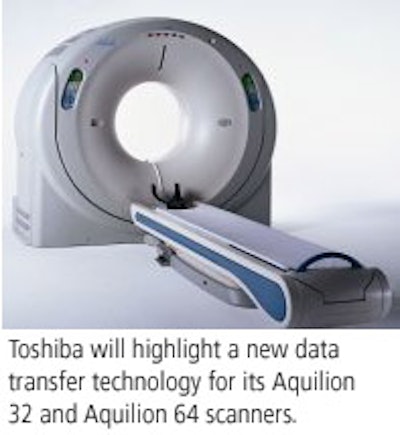
Aquilion 64 features a 64-row detector with 400 msec gantry rotation, collecting 32 mm of detector coverage per rotation with 0.35-mm isotropic voxels. The system features a package of scanning applications including cardiac scoring, cardiac angiography, CT fluoroscopy, high-resolution lung scanning and CAD, and bone mineral analysis. The system carries a list price between $2.5 million and $2.7 million.

New on Aquilion 64 is a new data transfer technology that Toshiba is calling Enhanced DICOM Data Transfer. The technique enables seamless data transfer between 32- and 64-slice Aquilion scanners to workstations from Toshiba's visualization partner Vital Images of Minnetonka, MN. Toshiba believes the work-in-progress technology will dramatically improve workflow and efficiency for Aquilion users.
Aquilion 64 CFX is a dedicated cardiac version of Aquilion 64. It features many of the same scanning parameters as the general radiology version, but also includes specialized cardiac scanning protocols like SUREWorkflow to automate and simplify cardiac exams. Purchasers of the system also receive CFX Cardio physician training to help them gain the tools needed for cardiac scanning with the system, according to the company. The system carries a list price of $2.7 million to $2.9 million.
Aquilion LB is a specialized version of the Aquilion family that features a 90-cm gantry aperture and scanning field of 70 cm. This provides additional flexibility to users in interventional, bariatric, and oncology CT simulation procedures. The system carries a list price of $1.4 million to $1.7 million.
By Brian Casey
AuntMinnie.com staff writer
November 4, 2005
Copyright © 2005 AuntMinnie.com