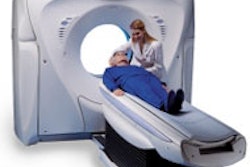
LightSpeed Pro16 -- a 16-slice scanner with routine 0.4-second gantry rotation -- will take center stage in the CT section of GE’s booth. The scanner employs the Waukesha, WI, company’s HiLight Matrix II detector, which supports imaging at 16 x 0.625-mm and 16 x 1.25-mm slice thicknesses in all scan modes and at all scan speeds, according to the company. The device was introduced in June 2003.
LightSpeed Pro16 also employs a new x-ray tube and generator, and users can choose to emphasize the small focal spot to improve visualization of small anatomic structures. The tube’s faster cooling rate enables longer thin-slice studies, the company said.

GE will talk up Xtream, a new package of CT enhancements that was also introduced in mid-2003. Xtream features a new operator console platform with faster data reconstruction and transfer speeds.
Radiologists using Xtream can access the first image in a study up to 70% faster than with previous operator consoles, thus improving workflow, according to GE. The technology features reconstruction at six frames per second (fps) at full resolution for images of any slice thickness, and image transfer rates of 10 fps for sending data to a post-processing or PACS workstation.
Xtream is available on new and previously installed scanners in the LightSpeed family, as well as on GE’s older HiSpeed QX/i models.
Finally, LightSpeed RT is a new four-slice CT scanner, optimized for radiation therapy planning, that was unveiled in October. The product features a wider patient bore and a 65-cm display field of view, larger than conventional 50-cm fields of view. The scanner includes processing applications such as Advantage 4D, GE’s respiratory gating software for tumor and organ motion assessment and margin localization.