GE HealthCare (GEHC) and the University of Washington (UW) Department of Radiology have launched a strategic imaging research collaboration.
The collaboration will focus on advancing CT and molecular imaging technologies for cardiology, oncology, and theranostics workflows, with work to take place at UW Medicine Radiology facilities in Seattle.
It expands on a 30-year relationship between the two organizations that has produced more than 80 collaborative research projects and 100 academic publications. Prior joint work includes clinical input on GEHC's Discovery and Omni PET/CT platforms and research supporting the company's ECG-less cardiac CT capability.
The partnership is structured around two research programs. The CT program will pursue clinical evidence for spectral imaging technologies and workflow automation. The molecular imaging and theranostics program will focus on developing clinical evidence for emerging imaging techniques, applying deep learning to treatment planning and clinical trial matching, and advancing image processing for oncology applications.
The collaboration is led on the UW side by Dushyant Sahani, MD, professor and chairman of UW Medicine Radiology, and Paul Kinahan, PhD, vice chair for research and professor of radiology at the UW School of Medicine.


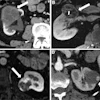
![Axial images from unenhanced calcium score cardiac CT (left) and curved planar reformation images from CT angiography (right) show that higher long-term exposure to air pollution is associated with greater coronary artery calcium and more obstructive coronary artery disease (CAD). Top row: Images in a 68-year-old male patient with higher 10-year mean ambient air pollution exposure (7.9 μg/m3 for particulate matter measuring ≤2.5 μm in diameter [PM2.5] and 17.4 parts per billion [ppb] for NO2) with extensive CAD (coronary artery calcium score [CACS] >1,000 and obstructive CAD [≥70% diameter stenosis]). Bottom row: Images in a 57-year-old female patient with lower 10-year mean ambient air pollution exposure (6.3 μg/m3 for PM2.5 and 4.6 ppb for NO2) with no CAD (CACS = 0 and no obstructive stenosis).](https://img.auntminnie.com/mindful/smg/workspaces/default/uploads/2026/06/hanneman.r6SMLzkezo.png?auto=format%2Ccompress&fit=crop&h=100&q=70&w=100)


![Axial images from unenhanced calcium score cardiac CT (left) and curved planar reformation images from CT angiography (right) show that higher long-term exposure to air pollution is associated with greater coronary artery calcium and more obstructive coronary artery disease (CAD). Top row: Images in a 68-year-old male patient with higher 10-year mean ambient air pollution exposure (7.9 μg/m3 for particulate matter measuring ≤2.5 μm in diameter [PM2.5] and 17.4 parts per billion [ppb] for NO2) with extensive CAD (coronary artery calcium score [CACS] >1,000 and obstructive CAD [≥70% diameter stenosis]). Bottom row: Images in a 57-year-old female patient with lower 10-year mean ambient air pollution exposure (6.3 μg/m3 for PM2.5 and 4.6 ppb for NO2) with no CAD (CACS = 0 and no obstructive stenosis).](https://img.auntminnie.com/mindful/smg/workspaces/default/uploads/2026/06/hanneman.r6SMLzkezo.png?auto=format%2Ccompress&fit=crop&h=112&q=70&w=112)