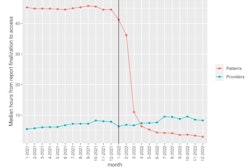
While most patients still receive their cancer diagnosis through communication from their clinical team, more are accessing patient portals to get their diagnosis, according to research published June 24 in JAMA Network Open.
And about half of patients who received their initial cancer diagnosis via portal delivery had imaging results go with their diagnosis, wrote a team led by Sheena Bhalla, MD, from the University of Texas Southwestern Medical Center in Dallas.
“Nonetheless, there is unlikely to be a one-size-fits all approach, evidenced by preference differences we observed according to patient sex, frequency of portal use, and prior delivery of cancer diagnosis,” the Bhalla team wrote.
The Information Blocking Provision of the 21st Century Cures Act Final Rule mandates that patients have timely, unrestricted access to their electronic health information. Bhalla and colleagues noted that few studies have examined how patients perceive immediate release of their results.
The researchers explored trends in the experiences and communication preferences of patients who received a cancer diagnosis before and after the Cures Act implementation. They included data from 2,412 surveyed patients in their final analysis.
Of the survey respondents, 1,923 (84%) received their cancer diagnosis through communication from their clinical team, either through in-person visit, telemedicine visit, or telephone.
And 170 respondents (7%) learned their cancer diagnosis through the team’s institutional patient portal. Of these patients, 72 (45%) received imaging results with their cancer diagnosis. And most patients (71%) received their results while at home.
For future communication of new or recurrent cancer diagnoses, 1,724 respondents (75%) preferred clinician communication while 535 (23%) preferred portal delivery.
The team also reported the following findings:
About 79% of patients who initially received a cancer diagnosis prefer clinician communication for future diagnoses, while about 20% preferred portal delivery.
Of patients who initially received a portal-delivered diagnosis, about 54% preferred this notification method for a future cancer diagnosis, while 42% preferred initial clinician delivery.
Among 361 respondents (15%) who reported a cancer recurrence, 234 (67%) learned through clinician communication and 97 (27%) learned through the portal.
For the portal group, 14% of patients discussed results with their clinical team within one day, 45% within three days, and 78% within one week.
Finally, for patients who used portal delivery for their initial cancer diagnosis, 59% were alone at the time they accessed their results. These patients more often searched for more information in several ways, most commonly internet searches (48%).
The study authors suggested that future research could focus on the effectiveness of tiered results delivery, AI-generated plain-language summaries, and opt-in methods for immediate result delivery.
“Such tailored approaches may mitigate some of the unintended consequences of real-time access to potentially confusing, sensitive, and life-changing data such as new or recurrent cancer diagnosis,” they wrote.
Read the full study here.