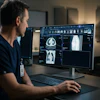
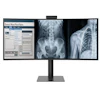
PACS workstations are a substantial and underrecognized source of power consumption in radiology departments, consuming up to 24.99 kW when fully operational across 105 units, with research showing that short idle periods can justify reduced-power states to improve energy efficiency and reduce environmental impact.
- PACS workstations consume 24.99 kW total power at full departmental operation across 105 units
- Non-active states show 18.37 kW in logged-off mode and 2.41 kW in powered-down mode
- Power consumption varies up to 7.61-fold across different operating modes
- Break-even times are 6.67 minutes for logged-off to active and 5.86 minutes for powered-down to active states
- Optimized workstation power management can significantly reduce radiology's environmental footprint and operational costs
PACS workstations may be a “substantial and likely underrecognized” source of power consumption in radiology, according to research published September 22 in Cureus.
A group led by Anna Kühn, MD, from the University of Massachusetts in Worcester found that PACS workstations in an academic department consume power at a substantial level, with little measurement variability across workstations in hospital- and home-based setups.
“Our study… provides intuitive and simple tools that can help radiologists to estimate the power consumption of their PACS workstations and to optimize workstation power management based on quantitative and evidence-based criteria,” the Kühn group wrote.
While CT and MRI scanners are under the microscope for sustainability efforts in radiology, PACS workstations may contribute to energy efficiency challenges in a cumulative manner. The researchers suggested this is because of their number and “virtually ubiquitous” global deployment.
Kühn and colleagues measured how much power PACS workstations consume across common operating modes, including the following: active, standby, powered-down, and transition states. They focused on three PACS workstations, including two hospital-based setups and one home-based setup. The researchers measured departmental consumption by scaling per-workstation data to 105 units. From there, they benchmarked the data against common household appliances.
The team reported low measurement variability, with no significant differences between repetitions or from including mammography workstations. It also highlighted the following findings:
Total power consumption at the departmental level reached 24.99 kW in full operation.
Non-active states showed 18.37 kW of power consumption in logged off states and 2.41 kW in powered down states.
Mode comparisons showed up to 7.61-fold differences in power consumption.
Break-even times were 6.67 minutes for logged-off to active states and 5.86 minutes for powered-down to active states.
The finding on break-even times suggest short idle periods justify reduced-power states, the researchers wrote. They highlighted that such decision tool can “support more energy-efficient workstation management and reduce the environmental impact of radiology operations.”
“While radiologists pause and sleep, PACS stations rarely do, as shown by our observations, which may find practical applications and thereby help to reduce the environmental footprint of radiology,” the authors added.
Read the full study here.