Beth Israel Deaconess Medical Center (BIDMC) in Boston has administered its first clinical cancer risk score using Clairity Breast, a U.S. Food and Drug Administration (FDA)-authorized AI tool for mammogram-based breast cancer risk assessment.
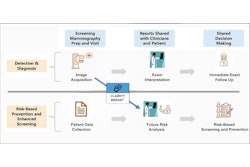
Clairity Breast, which was authorized through the de novo pathway, produces a five-year breast cancer risk score directly from a routine screening mammogram, according to the company. The tool integrates into existing imaging and reporting workflows, allowing providers to order, review, and document results within established systems, Clairity said.
Patients can request a Clairity Breast assessment through BIDMC – Chestnut Hill Square at a routine screening mammogram appointment or through their medical provider, BIDMC said. Results are then reviewed by the provider, with the option to be seen by a breast health specialist at the Breast Care Center at BIDMC if desired.





![A normal mammogram confirmed by three-year radiologic follow-up illustrates reader-marked regions of interest (ROIs) during (A) unaided (round 1) and (B) artificial intelligence (AI)–assisted (round 2) reading. Each colored dot represents an ROI for recall by a human reader. Readers could mark more than one ROI per case, represented by multiple dots of the same color. During AI-assisted reading, the AI system displayed three visible prompts: two with suspicion of malignancy scores of 35% (left mediolateral oblique [L MLO] and craniocaudal [L CC]) and one with a suspicion of malignancy score of 10% (right craniocaudal [R CC]), shown as polygonal overlays. Without AI, six of 10 readers (60%) marked a false-positive ROI. With AI assistance, this fell to two of 10 (20%). R MLO = right mediolateral oblique.](https://img.auntminnie.com/mindful/smg/workspaces/default/uploads/2026/07/2026-07-14-radiology-mammogram-ai-auto-bias.H0bYO8QlWs.jpg?auto=format%2Ccompress&fit=crop&h=112&q=70&w=112)


