Women's imaging vendor Hologic posted 2019 fiscal second-quarter revenues that outperformed its previous guidance, thanks to continued growth in its breast health and molecular diagnostics businesses.
For the period (end-March 30), Hologic had $818.4 million in revenue, up 3.7% on a nominal basis and up 5.2% on a currency-comparable basis from the $789.3 million reported in the fiscal second quarter of 2018. Molecular diagnostics revenue increased 12.8% on a currency-comparable basis, while breast health revenue climbed 8.4% on a currency-comparable basis.
The company had a net loss under generally accepted accounting principles (GAAP) of $272.6 million, including $443.8 million in non-cash impairment charges for intangible assets and equipment in its medical aesthetics business. Hologic had a GAAP net loss of $681.4 million in the same period a year ago, which also included impairment charges from the medical aesthetics unit. The firm noted that its adjusted non-GAAP earnings before interest, taxes, depreciation, and amortization (EBITDA) reached $254.1 million, up 2.4% from the same period a year ago.
The second-quarter results led Hologic to raise its full-year guidance for revenue and non-GAAP earnings per share (EPS). The vendor now expects fiscal 2019 revenues will increase by a range of 4.3% to 4.9% on a constant currency basis, up from its previous guidance of 3.3% to 3.9%. In addition, EPS is now projected to grow by 8.1% to 9.4%, an increase from its previous guidance of 7.2% to 9%.
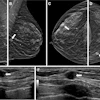


![A normal mammogram confirmed by three-year radiologic follow-up illustrates reader-marked regions of interest (ROIs) during (A) unaided (round 1) and (B) artificial intelligence (AI)–assisted (round 2) reading. Each colored dot represents an ROI for recall by a human reader. Readers could mark more than one ROI per case, represented by multiple dots of the same color. During AI-assisted reading, the AI system displayed three visible prompts: two with suspicion of malignancy scores of 35% (left mediolateral oblique [L MLO] and craniocaudal [L CC]) and one with a suspicion of malignancy score of 10% (right craniocaudal [R CC]), shown as polygonal overlays. Without AI, six of 10 readers (60%) marked a false-positive ROI. With AI assistance, this fell to two of 10 (20%). R MLO = right mediolateral oblique.](https://img.auntminnie.com/mindful/smg/workspaces/default/uploads/2026/07/2026-07-14-radiology-mammogram-ai-auto-bias.H0bYO8QlWs.jpg?auto=format%2Ccompress&fit=crop&h=100&q=70&w=100)


![A normal mammogram confirmed by three-year radiologic follow-up illustrates reader-marked regions of interest (ROIs) during (A) unaided (round 1) and (B) artificial intelligence (AI)–assisted (round 2) reading. Each colored dot represents an ROI for recall by a human reader. Readers could mark more than one ROI per case, represented by multiple dots of the same color. During AI-assisted reading, the AI system displayed three visible prompts: two with suspicion of malignancy scores of 35% (left mediolateral oblique [L MLO] and craniocaudal [L CC]) and one with a suspicion of malignancy score of 10% (right craniocaudal [R CC]), shown as polygonal overlays. Without AI, six of 10 readers (60%) marked a false-positive ROI. With AI assistance, this fell to two of 10 (20%). R MLO = right mediolateral oblique.](https://img.auntminnie.com/mindful/smg/workspaces/default/uploads/2026/07/2026-07-14-radiology-mammogram-ai-auto-bias.H0bYO8QlWs.jpg?auto=format%2Ccompress&fit=crop&h=112&q=70&w=112)