Growth in digital mammography service revenues, higher tomosynthesis sales, and revenue contribution from a recent acquisition helped pace a 30% increase in revenue for women's imaging vendor Hologic in its fiscal second quarter. But the firm's net loss also increased.
For the period (end-March 30), the company had revenues of $612.7 million, up from $471.2 million in the second quarter last year. Hologic had a net loss of $51.1 million, compared with a net loss of $40.3 million a year ago.
Hologic said the revenue gains benefited from the inclusion of $160 million in revenues from Gen-Probe, which Hologic bought in August 2012.
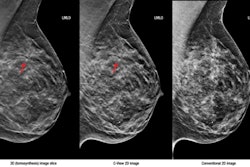
The firm also cited the increase in service revenues from its installed base of digital mammography systems, as well as higher sales of tomosynthesis systems, breast biopsy products, and MyoSure hysteroscopic tissue-removal systems. The overall revenue increase was partially offset by lower sales of legacy diagnostic products, 2D Selenia and 2D Dimensions mammography systems, NovaSure endometrial ablation systems, and Adiana permanent contraception systems.
Among positive signs, the company also pointed to its non-generally accepted account principles (GAAP) adjusted net income, which increased to $93.8 million from non-GAAP adjusted net income of $86.8 million a year ago.
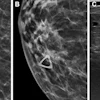


![A normal mammogram confirmed by three-year radiologic follow-up illustrates reader-marked regions of interest (ROIs) during (A) unaided (round 1) and (B) artificial intelligence (AI)–assisted (round 2) reading. Each colored dot represents an ROI for recall by a human reader. Readers could mark more than one ROI per case, represented by multiple dots of the same color. During AI-assisted reading, the AI system displayed three visible prompts: two with suspicion of malignancy scores of 35% (left mediolateral oblique [L MLO] and craniocaudal [L CC]) and one with a suspicion of malignancy score of 10% (right craniocaudal [R CC]), shown as polygonal overlays. Without AI, six of 10 readers (60%) marked a false-positive ROI. With AI assistance, this fell to two of 10 (20%). R MLO = right mediolateral oblique.](https://img.auntminnie.com/mindful/smg/workspaces/default/uploads/2026/07/2026-07-14-radiology-mammogram-ai-auto-bias.H0bYO8QlWs.jpg?auto=format%2Ccompress&fit=crop&h=100&q=70&w=100)


![A normal mammogram confirmed by three-year radiologic follow-up illustrates reader-marked regions of interest (ROIs) during (A) unaided (round 1) and (B) artificial intelligence (AI)–assisted (round 2) reading. Each colored dot represents an ROI for recall by a human reader. Readers could mark more than one ROI per case, represented by multiple dots of the same color. During AI-assisted reading, the AI system displayed three visible prompts: two with suspicion of malignancy scores of 35% (left mediolateral oblique [L MLO] and craniocaudal [L CC]) and one with a suspicion of malignancy score of 10% (right craniocaudal [R CC]), shown as polygonal overlays. Without AI, six of 10 readers (60%) marked a false-positive ROI. With AI assistance, this fell to two of 10 (20%). R MLO = right mediolateral oblique.](https://img.auntminnie.com/mindful/smg/workspaces/default/uploads/2026/07/2026-07-14-radiology-mammogram-ai-auto-bias.H0bYO8QlWs.jpg?auto=format%2Ccompress&fit=crop&h=112&q=70&w=112)