The global market for full-field digital mammography (FFDM) could expand at a compound annual growth rate of 8% over the next five years, according to a new report by market research firm GlobalData.
The firm valued the worldwide FFDM sector at $801.2 million in 2010 and predicts that it will exceed $1.3 billion in 2017. The prime driver will be the increasing preference for FFDM systems due to technological advancements and rising reimbursement.
The report also noted that the U.S. Food and Drug Administration (FDA) reclassification of FFDM devices from class III to class II in 2010 could drive growth.
A combination of other modalities, such as ultrasound and MRI with mammography for improved breast cancer detection, is also expected to fuel the market. In addition, FFDM systems will continue to replace film-screen mammography devices to meet greater patient volume and improved detection of breast cancer, according to GlobalData.



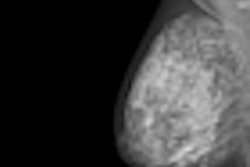
![A normal mammogram confirmed by three-year radiologic follow-up illustrates reader-marked regions of interest (ROIs) during (A) unaided (round 1) and (B) artificial intelligence (AI)–assisted (round 2) reading. Each colored dot represents an ROI for recall by a human reader. Readers could mark more than one ROI per case, represented by multiple dots of the same color. During AI-assisted reading, the AI system displayed three visible prompts: two with suspicion of malignancy scores of 35% (left mediolateral oblique [L MLO] and craniocaudal [L CC]) and one with a suspicion of malignancy score of 10% (right craniocaudal [R CC]), shown as polygonal overlays. Without AI, six of 10 readers (60%) marked a false-positive ROI. With AI assistance, this fell to two of 10 (20%). R MLO = right mediolateral oblique.](https://img.auntminnie.com/mindful/smg/workspaces/default/uploads/2026/07/2026-07-14-radiology-mammogram-ai-auto-bias.H0bYO8QlWs.jpg?auto=format%2Ccompress&fit=crop&h=112&q=70&w=112)


