
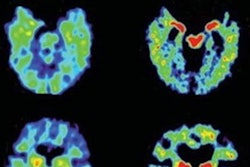
Radiopharmaceutical developer CereMark announced that additional patents have been awarded to the University of California, Los Angeles (UCLA) for a PET agent that the company licensed from the university for the imaging of Alzheimer's disease.
The patents are associated with F-18 flornaptitril (also known as F-18 FDDNP), a biomarker for the detection, development, and progression of Alzheimer's disease, as well as chronic traumatic encephalopathy and other neurodegenerative diseases.
The patents cover a synthesizing method that allows for high radiochemical yields and short manufacturing times for administration.
CereMark is UCLA's only licensee for the development and commercialization of F-18 flornaptitril, and the company is preparing for a phase 3 clinical multisite study required for U.S. Food and Drug Administration approval.


![Comparative PET/CT scan images showing [18F]FAPI and [18F]FDG imaging with MIP projections, fusion views, and CT cross-sections for medical diagnosis](https://img.auntminnie.com/mindful/smg/workspaces/default/uploads/2026/10/fapi-vs-fdg.nL6Acp6W2i.jpg?auto=format%2Ccompress&fit=crop&h=100&q=70&w=100)




![Comparative PET/CT scan images showing [18F]FAPI and [18F]FDG imaging with MIP projections, fusion views, and CT cross-sections for medical diagnosis](https://img.auntminnie.com/mindful/smg/workspaces/default/uploads/2026/10/fapi-vs-fdg.nL6Acp6W2i.jpg?auto=format%2Ccompress&dpr=2&fit=crop&h=167&q=70&w=250)


