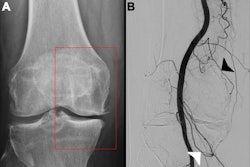
Genicular artery embolization (GAE) is safe and provides pain relief and functional improvement in participants with osteoarthritis-related knee symptoms for at least 12 months, according to a study published June 16 in Radiology.
The finding is from a prospective assessment of the minimally invasive procedure in 194 participants using rapidly resorbable gelatin-based microspheres (RRGMs), new embolic agents designed to dissolve within hours, noted Florian Fleckenstein, MD, of Charité – Universitätsmedizin Berlin, and colleagues.
“We believe these results carry real weight because they come from real-world data,” Fleckenstein said in a RSNA release. “In our cohort, we saw a significant drop in pain and a significant increase in function, including sports and recreation and daily activity. Most importantly, their quality of life significantly increased.”
According to the World Health Organization, knee osteoarthritis affects over 365 million adults worldwide and is one of the leading contributors to disability. In an osteoarthritic knee, abnormal vessels build up around the joint and drive inflammation and pain. During GAE, an interventional radiologist guides a thin catheter directly to each affected vessel and injects tiny particles to block it, calming the inflammation and easing the pain without surgery.
RRGMs are size-calibrated embolic agents designed to dissolve within hours, and potentially may overcome limitations with existing agents currently in use, such as limited availability, off-label use, antimicrobial resistance, and nontarget embolization, the authors noted.
To test the new approach, the group recruited 194 participants with knee osteoarthritis refractory to at least three months of conservative care. Participants underwent 239 GAE procedures using RRGMs between July and November 2024. Forty-five participants received bilateral treatment.
Five interventional radiologists performed all procedures following a standardized protocol. Pain and function were assessed at baseline and at six weeks and three, six, and 12 months using the numeric rating scale (NRS, scored on a scale of zero to 10) and the Knee Injury and Osteoarthritis Outcome Score (KOOS, scored on a scale of zero to 100).
 Digital subtraction angiography images of the right knee joint of a 62-year-old participant with predominantly medial knee osteoarthritis. (A) Peri-interventional image of the popliteal artery. Yellow arrow indicates the descending genicular artery, and blue arrow indicates the medial inferior genicular artery. (B, C) Selective preinterventional images show hypervascularity of two branches of the genicular artery: the (B) descending genicular artery (arrow) and the (C) medial inferior genicular artery (arrow). (D, E) Selective postinterventional images obtained after embolization with rapidly resorbable gelatin-based microspheres. Complete elimination of the blush is observed, with preserved perfusion of the proximal arterial segments.RSNA
Median NRS pain scores fell from seven at baseline to three at 12 months. KOOS scores improved across all five domains: pain, symptoms, daily activity, sports and recreation, and quality of life. At 12 months, 55% to 80% of participants exceeded the minimum clinically important difference across KOOS scores.
"RRGMs represent a novel embolic agent, offering a favorable balance between safety and efficacy while avoiding limitations associated with permanent microspheres and imipenem-cilastatin," the group wrote.
The authors noted limitations, namely that no objective functional performance measures or imaging-based end points were included in the study. However, at present, no validated objective outcome parameters have been established for GAE, and patient-reported outcomes remain the most adopted end points for assessing response, they wrote.
“While midterm outcomes are promising, long-term data beyond 12 months are needed to determine the long-term durability of the observed benefits,” the group concluded.
The full study is available here.