GE HealthCare (GEHC) has received 510(k) clearance from the U.S. Food and Drug Administration (FDA) for Photonova Spectra, a photon-counting computed tomography system powered by the company's Deep Silicon detector technology.
GEHC's Photonova Spectra PCCT system
The system features 8-bin energy resolution and wide detector coverage with a 0.23-second rotation speed, according to the company. Deep Silicon enables precise measurement of photon energy and supports material separation and characterization, allowing the system to distinguish between iodine, calcium, and fat, GEHC said. Photonova Spectra simultaneously captures spectral and ultrahigh-definition spatial data in a single scan without special setup or multiple protocols, the company noted.
The system incorporates NVIDIA accelerated computing technology and is designed to fit into existing GE HealthCare CT-ready rooms with minimal modification, according to the firm. The company is collaborating with University of Wisconsin-Madison and Stanford Medicine as the first U.S. clinical evaluation sites, it said.
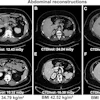



![Axial images from unenhanced calcium score cardiac CT (left) and curved planar reformation images from CT angiography (right) show that higher long-term exposure to air pollution is associated with greater coronary artery calcium and more obstructive coronary artery disease (CAD). Top row: Images in a 68-year-old male patient with higher 10-year mean ambient air pollution exposure (7.9 μg/m3 for particulate matter measuring ≤2.5 μm in diameter [PM2.5] and 17.4 parts per billion [ppb] for NO2) with extensive CAD (coronary artery calcium score [CACS] >1,000 and obstructive CAD [≥70% diameter stenosis]). Bottom row: Images in a 57-year-old female patient with lower 10-year mean ambient air pollution exposure (6.3 μg/m3 for PM2.5 and 4.6 ppb for NO2) with no CAD (CACS = 0 and no obstructive stenosis).](https://img.auntminnie.com/mindful/smg/workspaces/default/uploads/2026/06/hanneman.r6SMLzkezo.png?auto=format%2Ccompress&fit=crop&h=100&q=70&w=100)


![Axial images from unenhanced calcium score cardiac CT (left) and curved planar reformation images from CT angiography (right) show that higher long-term exposure to air pollution is associated with greater coronary artery calcium and more obstructive coronary artery disease (CAD). Top row: Images in a 68-year-old male patient with higher 10-year mean ambient air pollution exposure (7.9 μg/m3 for particulate matter measuring ≤2.5 μm in diameter [PM2.5] and 17.4 parts per billion [ppb] for NO2) with extensive CAD (coronary artery calcium score [CACS] >1,000 and obstructive CAD [≥70% diameter stenosis]). Bottom row: Images in a 57-year-old female patient with lower 10-year mean ambient air pollution exposure (6.3 μg/m3 for PM2.5 and 4.6 ppb for NO2) with no CAD (CACS = 0 and no obstructive stenosis).](https://img.auntminnie.com/mindful/smg/workspaces/default/uploads/2026/06/hanneman.r6SMLzkezo.png?auto=format%2Ccompress&fit=crop&h=112&q=70&w=112)