A new CMS quality measure called ExRad found that nearly 31% of CT scans exceed recommended radiation doses across U.S. facilities, with performance varying widely from 1.8% to 82.4% out of range.
- 30.7% of CT scans exceeded radiation thresholds for their exam type across 254 facilities
- Facility performance ranged dramatically from 1.8% to 82.4% out-of-range rates, showing high-performing facilities achieve excellent results with existing technology
- Three routine CT categories (abdomen/pelvis, chest, head) accounted for 71.9% of all excessive radiation scans
- Standardizing CT protocols to meet ExRad thresholds could prevent approximately 24,000 radiation-induced cancers annually in the United States
- ExRad reporting began voluntarily in January 2025 as the first automated, outcome-based CT quality measure in CMS payment programs
Performance varies widely across facilities reporting under the first automated, outcome-based CT quality measure adopted into Medicare payment programs, according to a study published November 2 in the Journal of the American College of Radiology.
Rebecca Smith-Bindman, MD, of the University of California San Francisco, and colleagues assessed how facilities performed on the U.S. Centers for Medicare and Medicaid Services' (CMS) “ExRad” measure, with findings revealing that nearly one in three scans (30.7%) exceeded the radiation threshold for its exam type, while almost none (0.06%) fell short on image quality.
"Early results from 254 facilities are both encouraging and sobering," the group wrote. "The wide variation in performance, both across and within facilities, indicates substantial opportunities for improvement, and near-zero out-of-range rates at some facilities, for the same body regions in which other facilities have high rates, demonstrate that excellent performance is achievable with existing technology."
Studies have linked CT exams in excess of recommended thresholds to radiation-related lifetime cancer risk, the authors explained. To address variation in radiation doses, CMS adopted the Excessive Radiation Dose or Inadequate Image Quality for Diagnostic CT in Adults [ExRad]) measure into three quality reporting programs, with voluntary reporting beginning in January 2025. The measure evaluates whether a CT scan used more radiation than necessary for the patient’s indication or produced images too noisy to interpret.
In this CMS-supported study, the researchers characterized early ExRad performance. The analysis encompassed 783,634 adult CT examinations from 254 voluntarily reporting facilities across 16 CT categories, covering May 2025 through August 2026.
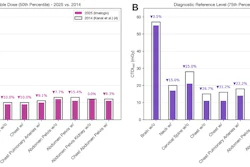
According to the analysis, facility ExRad scores ranged from 1.8% to 82.4% out of range, with those at the 90th percentile logging 4.6 times more out-of-range scans than facilities at the 10th. Three high-volume routine-dose categories (abdomen and pelvis, chest, and head) accounted for 71.9% of all out-of-range examinations while representing 56% of imaging volume.
Within individual facilities, the median gap between a facility’s best- and worst-performing CT category was 74 percentage points (IQR 49-89), and cross-category consistency was weak (ICC = 0.12), indicating that most variation was attributable to specific facility-category combinations rather than to facilities or categories alone, the group reported.
"Early implementation data from the first automated, outcome-based CT quality measure in CMS payment programs demonstrate substantial variation in performance across and within facilities," the researchers wrote.
The near-zero dose out-of-range percentages in some categories, alongside much higher percentages in others, likely reflect differences in how thoroughly protocols for those examinations have been standardized and optimized, the researchers wrote. Since some facilities performed well in some CT categories and less well in others, each facility may need its own category-level results to determine which protocols to target, they added.
"Broad adherence to ExRad thresholds in the United States could meaningfully reduce the projected number of radiation-induced cancers: We have previously estimated that approximately 23% of the projected 103,000 radiation-induced cancers attributable to current CT use each year (around 24,000) could be avoided annually if all examinations met ExRad thresholds," the group concluded.
The full study is available here.