Advocate Aurora Health is the first hospital network in the U.S. to launch an iodine recycling program offered by GE Healthcare.
The program enables hospitals around the world to collect and return unused GE iodine-based imaging contrast media that otherwise would be left unused. Under the program, Advocate Aurora will collect and return unused iodine-based contrast media from its hospitals in Illinois and Wisconsin for reprocessing. The hospitals are provided with containers to safely store any uncontaminated and unused contrast media.
Once full, the containers are sealed and returned to GE Healthcare's Active Pharmaceutical Ingredients (API) facility in Lindesnes, Norway, using existing distribution routes, where the collected material is then used to produce additional contrast media, the company said.
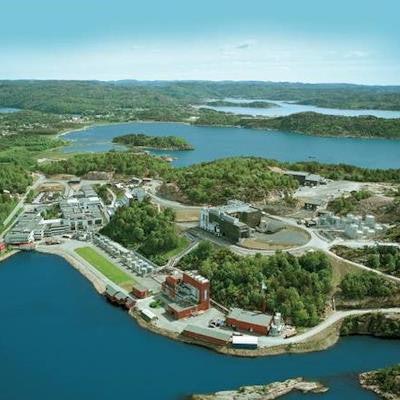
GE Healthcare's manufacturing facility in Lindesnes, Norway. Photo courtesy of GE Healthcare.Iodine is a nonrenewable resource, with about 18% of the global demand currently being reused, Advocate Aurora said. In the U.S., more than 40% of CT procedures use contrast media, but once a required dose is extracted from a vial, any remaining substance is typically discarded.
GE's contrast media recycling program was initially launched in Norway in 2006. The program has since been rolled out across 11 countries in Europe, with Canada and the U.S. launching programs this year.





![Images show the pectoralis muscles of a healthy male individual who never smoked (age, 66 years; height, 178 cm; body mass index [BMI, calculated as weight in kilograms divided by height in meters squared], 28.4; number of cigarette pack-years, 0; forced expiratory volume in 1 second [FEV1], 97.6% predicted; FEV1: forced vital capacity [FVC] ratio, 0.71; pectoralis muscle area [PMA], 59.4 cm2; pectoralis muscle volume [PMV], 764 cm3) and a male individual with a smoking history and chronic obstructive pulmonary disorder (COPD) (age, 66 years; height, 178 cm; BMI, 27.5; number of cigarette pack-years, 43.2, FEV1, 48% predicted; FEV1:FVC, 0.56; PMA, 35 cm2; PMV, 480.8 cm3) from the Canadian Cohort Obstructive Lung Disease (i.e., CanCOLD) study. The CT image is shown in the axial plane. The PMV is automatically extracted using the developed deep learning model and overlayed onto the lungs for visual clarity.](https://img.auntminnie.com/mindful/smg/workspaces/default/uploads/2026/03/genkin.25LqljVF0y.jpg?auto=format%2Ccompress&crop=focalpoint&fit=crop&h=100&q=70&w=100)


![Images show the pectoralis muscles of a healthy male individual who never smoked (age, 66 years; height, 178 cm; body mass index [BMI, calculated as weight in kilograms divided by height in meters squared], 28.4; number of cigarette pack-years, 0; forced expiratory volume in 1 second [FEV1], 97.6% predicted; FEV1: forced vital capacity [FVC] ratio, 0.71; pectoralis muscle area [PMA], 59.4 cm2; pectoralis muscle volume [PMV], 764 cm3) and a male individual with a smoking history and chronic obstructive pulmonary disorder (COPD) (age, 66 years; height, 178 cm; BMI, 27.5; number of cigarette pack-years, 43.2, FEV1, 48% predicted; FEV1:FVC, 0.56; PMA, 35 cm2; PMV, 480.8 cm3) from the Canadian Cohort Obstructive Lung Disease (i.e., CanCOLD) study. The CT image is shown in the axial plane. The PMV is automatically extracted using the developed deep learning model and overlayed onto the lungs for visual clarity.](https://img.auntminnie.com/mindful/smg/workspaces/default/uploads/2026/03/genkin.25LqljVF0y.jpg?auto=format%2Ccompress&crop=focalpoint&fit=crop&h=112&q=70&w=112)