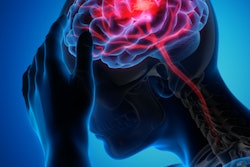
A 3D convolutional neural network (CNN) helps find large-vessel occlusions (LVOs) on head and neck CT angiography (CTA) studies -- which could translate to better patient outcomes, according to research presented at the recent virtual RSNA 2020 meeting.
"Time is brain, so getting patients treated sooner will help them retain more neurologic function," presenter Dr. Ian Pan of Rhode Island Hospital in Providence told session attendees.
Almost 800,000 people in the U.S. have a stroke each year, and about 10% of those are due to large-vessel occlusions. The use of artificial intelligence (AI) for detecting stroke is gaining momentum; in fact, in September, the U.S. Centers for Medicare and Medicaid Services (CMS) approved reimbursement for use of software developer Viz.ai's artificial intelligence (AI) application for stroke images.
"[The Viz.ai clearance] is a first for radiology artificial intelligence, and very exciting," Pan said.
Pan and colleagues sought to assess the performance of a deep learning algorithm in identifying LVOs. They trained a CCN with more than 7,000 LVO studies from Rhode Island Hospital and tested it on a set that consisted of 10% of these studies; the exams were classified into three categories:
- No LVO (83.5%)
- Chronic LVO (13.6%)
- Acute LVO (2.9%)
The team also used 683 positive LVO studies from the Hospital of the University of Pennsylvania as an independent test set.
Pan's group found that the CNN had a 96% accuracy rate and an area under the receiver operating curve (AUC) of 1 for categorizing LVOs and a 5% false-positive rate.
| CNN performance in categorizing LVOs | |
| Measure | Acute LVO versus no LVO |
| AUC | 0.824 |
| Specificity | 30% |
| Sensitivity | 95% |
"3D CNNs were effective in identifying series of interest and acute LVOs in CT angiography," Pan and colleagues wrote in their study abstract. "At a 5% false-positive rate, over 40% of acute LVOs would be successfully identified without manual intervention."
Additionally, the CNN had a 98.2% accuracy rate on the comparison data from the University of Pennsylvania, Pan noted.
Going forward, Pan hopes to develop the CNN's ability to localize LVOs rather than simply identifying if there is one or not -- research that could perhaps benefit from support from the RSNA, perhaps through its AI challenge initiative.
"Given that [the U.S. Centers for Medicare and Medicaid Services] is now reimbursing for [AI software for LVO], I'd love to see this as an RSNA AI challenge," he said.