Researchers from Japan were able to detect metastatic tumors in lymph nodes before they spread to other regions of the body by examining contrast visibility on micro-CT scans.
In a preclinical study, principal investigator Tetsuya Kodama, PhD, and colleagues from Tohoku University injected a contrast agent into the lymph nodes of mice with breast cancer. They tracked the flow of contrast through the lymph nodes on periodic micro-CT scans (Molecular Imaging and Biology, January 3, 2019).
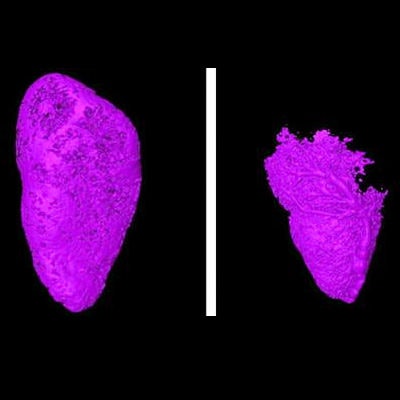
 From left to right, micro-CT scans show decreasing visibility of contrast (violet) in the lymph node as tumors grow within. Images courtesy of Tohoku University.
Approximately 28 days after the first injection, the researchers identified a noticeable reduction in contrast visibility within the lymph nodes, which they believe indicated the presence of cancer cells traveling through the lymph nodes to reach other regions of the body. This method could allow for the early detection of tumors before they fully metastasize, according to the group.