
The U.S. Food and Drug Administration (FDA) has cleared GE Healthcare's artificial intelligence (AI) algorithm for reviewing critical chest x-rays.
The company's Critical Care Suite is a collection of AI algorithms embedded on its Optima XR240amx mobile x-ray system. It was built in collaboration with the University of California, San Francisco (UCSF) using GE's Edison platform.
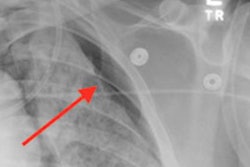
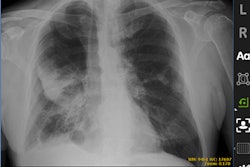
The software flags critical cases, reducing turnaround time for radiologists to review conditions such as suspected pneumothorax. It also detects acquisition errors and marks them for technologist review, so that corrections can be made before the image goes to the radiologist, GE said.






![A normal mammogram confirmed by three-year radiologic follow-up illustrates reader-marked regions of interest (ROIs) during (A) unaided (round 1) and (B) artificial intelligence (AI)–assisted (round 2) reading. Each colored dot represents an ROI for recall by a human reader. Readers could mark more than one ROI per case, represented by multiple dots of the same color. During AI-assisted reading, the AI system displayed three visible prompts: two with suspicion of malignancy scores of 35% (left mediolateral oblique [L MLO] and craniocaudal [L CC]) and one with a suspicion of malignancy score of 10% (right craniocaudal [R CC]), shown as polygonal overlays. Without AI, six of 10 readers (60%) marked a false-positive ROI. With AI assistance, this fell to two of 10 (20%). R MLO = right mediolateral oblique.](https://img.auntminnie.com/mindful/smg/workspaces/default/uploads/2026/07/2026-07-14-radiology-mammogram-ai-auto-bias.H0bYO8QlWs.jpg?auto=format%2Ccompress&fit=crop&h=112&q=70&w=112)


