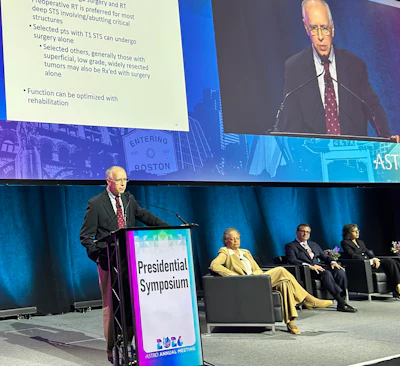
BOSTON -- Radiation therapy combined with surgery now preserves limbs in the vast majority of patients with extremity soft-tissue sarcoma, according to a presentation September 27 at the American Society of Radiation Oncology (ASTRO) annual meeting.
In a session on the importance of radiotherapy in organ preservation, Thomas DeLaney, MD, of Dartmouth-Hitchcock Medical Center in Lebanon, NH, reviewed decades of trial data on how radiation timing, dose, and patient selection affect local control and long-term limb function. He also highlighted ongoing trials that could reshape practice.
“In the 1970s, over 50% of extremity soft tissue sarcomas were treated by amputation,” DeLaney said. “Evidence of remarkable progress in oncologic care is that now approximately 95% of patients are currently treated with limb preservation.”
Sarcomas account for about 19,000 new U.S. cases annually. That is less than 1% of adult cancers but about 7% of pediatric cancers. Some 80% arise in soft tissue, and more than 75 histologic subtypes exist, making expert pathology review critical, DeLaney noted.
Surgery alone carries substantial recurrence risk. Local recurrence rates are 40% to 90% after marginal excision and 25% to 30% even after wide excision. Adding radiation cuts that figure to under 10%.
“Local recurrence matters because it has been linked to distant metastases and roughly three times the risk of sarcoma death in high-grade disease,” DeLaney said.
DeLaney drew on data from a randomized trial conducted by the U.S. National Cancer Institute (NCI) showing that limb-sparing surgery plus radiation achieved local control of roughly 85% to 90% of patients. In a second NCI trial, adjuvant radiation achieved local recurrence rates of 0% to 4% compared with 19% to 33% for surgery alone, Delaney noted.
In addition, Delaney discussed a trial conducted by the National Cancer Institute of Canada that compared preoperative and postoperative radiation in patients with extremity sarcoma. Wound complications occurred in 35% of preoperative patients versus 17% of postoperative patients. However, postoperative radiation uses larger fields and higher doses, which raises the risk of irreversible fibrosis, joint stiffness, and edema. ASTRO guidelines now favor preoperative radiation for most deep tumors, Delaney said.
Ultimately, most patients will undergo surgery and radiation, DeLaney concluded, although surgery alone remains appropriate for selected patients with small, superficial, low-grade, widely resected tumors.
“I’ve never had a patient come into clinic with a functional extremity requesting an amputation,” DeLaney said.
Check out AuntMinnie's full coverage of ASTRO 2026 on our ShowCast.