LOS ANGELES — A text message–based instruction program slashed late PET/CT appointment cancellations and saved $17,346 in annual F-18 FDG costs, according to a presentation at the Society of Nuclear Medicine and Molecular Imaging (SNMMI) annual meeting.
"One of the big problems that's posed are late appointment cancellations, which are leading to unused F-18 doses, and that leads to high operational costs and delayed patient care," said Kiara Schmidt, a nuclear medicine technology intern at Froedtert Health in Wauwatosa, WI.
Common causes of appointment cancellations include patient no-shows, same-day cancellations for personal reasons, non-compliance with pre-procedural instructions, and abnormal blood glucose, Schmidt explained. In 2022, the nuclear medicine department at Froedtert recorded 200 qualifying late cancellations, an 11.3% cancellation rate. No-shows led all categories at 33.5%, followed by abnormal blood glucose at 26%, failure to follow pre-procedural instructions at 24.5%, and same-day cancellations at 16%. At an institutional dose cost of approximately $110 per unit, those unused doses represented roughly $22,000 in waste, Schmidt said.
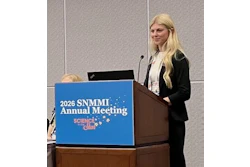
 Kiara Schmidt of Froedtert Health presented a study May 30 at the SNMMI annual meeting.
Compared to 2022, in 2025, reductions were observed across all categories, including blood glucose–related cancellations (84.6% decrease), no-shows (73.1%), failure to follow pre-procedural instructions (69.4%), and same-day cancellations (62.5%). Based on an institutional cost of $118 per F-18 FDG dose, the absolute reduction of 147 doses corresponds to an estimated annual cost avoidance of approximately $17,346 across the four categories of interest, Schmidt said.
IN addition, among 70 post-appointment survey respondents, appointment confirmations occurred via MyChart (45.7%), text message (31.4%), or phone call (22.9%). All patients who confirmed via text message opened the interactive eBook and reported that the instructions were clear. 98.6% of respondents expressed satisfaction with the appointment communication.
“Implementation of text confirmation with pre-procedural instructions significantly reduced late PET/CT cancellations that resulted in unused F-18 FDG doses,” Schmidt said.
Overall, the intervention improved patient compliance, optimized technologist workflows, reduced operational waste, and enhanced timely access to oncologic imaging, Schmidt noted.
“Text-based patient engagement is a scalable, effective strategy to improve PET/CT operational efficiency and quality of care,” she said.
The nuclear medicine department at Froedtert continues to refine workflows to further minimize late appointment cancellations, Schmidt concluded.
Check out AuntMinnie’s full coverage of SNMMI 2026 on our ShowCast.