Canadian provinces are experiencing policy changes on dense breast notification following screening mammography similar to what's being seen in the U.S.
Ontario recently became the seventh Canadian province to implement such a change, where women will be informed of their specific density category and the associated risks. This also may include a draft recommendation to provide supplemental screening for women with extremely dense breasts. Saskatchewan and Newfoundland and Labrador are also implementing notification laws in 2023.
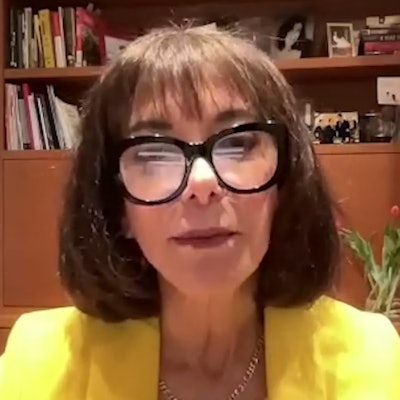
Dense Breasts Canada co-founder Jennie Dale and Paula Gordon, MD, volunteer medical advisor, spoke with AuntMinnie.com to discuss these policy changes and what's still needed. This includes the need for supplemental screening recommendations.
"In our first year of doing supplemental screening breast ultrasound, we found seven cancers per thousand screens," Gordon told AuntMinnie.com. "More radiologists might be willing to offer ultrasound screening if they saw how helpful it can be. The numbers in the literature, especially from the U.S. are far lower, since they screen annually, and more often with digital breast tomosynthesis."

![A normal mammogram confirmed by three-year radiologic follow-up illustrates reader-marked regions of interest (ROIs) during (A) unaided (round 1) and (B) artificial intelligence (AI)–assisted (round 2) reading. Each colored dot represents an ROI for recall by a human reader. Readers could mark more than one ROI per case, represented by multiple dots of the same color. During AI-assisted reading, the AI system displayed three visible prompts: two with suspicion of malignancy scores of 35% (left mediolateral oblique [L MLO] and craniocaudal [L CC]) and one with a suspicion of malignancy score of 10% (right craniocaudal [R CC]), shown as polygonal overlays. Without AI, six of 10 readers (60%) marked a false-positive ROI. With AI assistance, this fell to two of 10 (20%). R MLO = right mediolateral oblique.](https://img.auntminnie.com/mindful/smg/workspaces/default/uploads/2026/07/2026-07-14-radiology-mammogram-ai-auto-bias.H0bYO8QlWs.jpg?auto=format%2Ccompress&fit=crop&h=100&q=70&w=100)


![A normal mammogram confirmed by three-year radiologic follow-up illustrates reader-marked regions of interest (ROIs) during (A) unaided (round 1) and (B) artificial intelligence (AI)–assisted (round 2) reading. Each colored dot represents an ROI for recall by a human reader. Readers could mark more than one ROI per case, represented by multiple dots of the same color. During AI-assisted reading, the AI system displayed three visible prompts: two with suspicion of malignancy scores of 35% (left mediolateral oblique [L MLO] and craniocaudal [L CC]) and one with a suspicion of malignancy score of 10% (right craniocaudal [R CC]), shown as polygonal overlays. Without AI, six of 10 readers (60%) marked a false-positive ROI. With AI assistance, this fell to two of 10 (20%). R MLO = right mediolateral oblique.](https://img.auntminnie.com/mindful/smg/workspaces/default/uploads/2026/07/2026-07-14-radiology-mammogram-ai-auto-bias.H0bYO8QlWs.jpg?auto=format%2Ccompress&fit=crop&h=112&q=70&w=112)