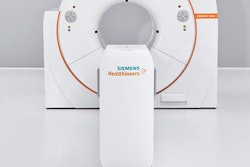
Siemens Healthineers has received U.S. Food and Drug Administration (FDA) clearance for Mammomat Revelation, the firm's new flagship digital mammography system.
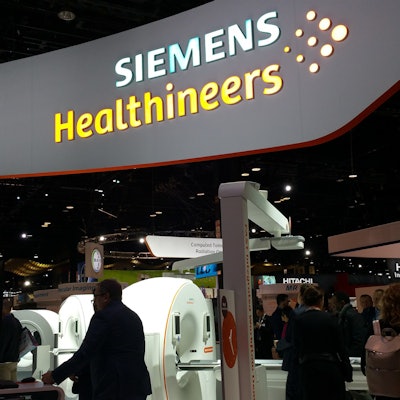
First introduced at RSNA 2017, Mammomat Revelation features the company's InSpect integrated specimen imaging tool for imaging and real-time review of biopsy samples at the workstation, according to Siemens. In addition, Revelation supports digital breast tomosynthesis (DBT) with a wide 50° arc of the system's x-ray tube head. This wide angle also serves as the basis for Revelation's HD Breast Biopsy capability, which is designed to provide one-click targeting of suspicious areas with an accuracy of ± 1 mm, Siemens said.
In other features, Revelation provides automated breast density measurements via its Personalized Soft Compression capability, in which the breast compression process is softened and the compression force is automatically and individually adjusted. The system also supports functional breast imaging with its titanium filter contrast-enhanced mammography mode, which enables users to acquire functional information with morphological detail, according to the company.
![A normal mammogram confirmed by three-year radiologic follow-up illustrates reader-marked regions of interest (ROIs) during (A) unaided (round 1) and (B) artificial intelligence (AI)–assisted (round 2) reading. Each colored dot represents an ROI for recall by a human reader. Readers could mark more than one ROI per case, represented by multiple dots of the same color. During AI-assisted reading, the AI system displayed three visible prompts: two with suspicion of malignancy scores of 35% (left mediolateral oblique [L MLO] and craniocaudal [L CC]) and one with a suspicion of malignancy score of 10% (right craniocaudal [R CC]), shown as polygonal overlays. Without AI, six of 10 readers (60%) marked a false-positive ROI. With AI assistance, this fell to two of 10 (20%). R MLO = right mediolateral oblique.](https://img.auntminnie.com/mindful/smg/workspaces/default/uploads/2026/07/2026-07-14-radiology-mammogram-ai-auto-bias.H0bYO8QlWs.jpg?auto=format%2Ccompress&fit=crop&h=100&q=70&w=100)


![A normal mammogram confirmed by three-year radiologic follow-up illustrates reader-marked regions of interest (ROIs) during (A) unaided (round 1) and (B) artificial intelligence (AI)–assisted (round 2) reading. Each colored dot represents an ROI for recall by a human reader. Readers could mark more than one ROI per case, represented by multiple dots of the same color. During AI-assisted reading, the AI system displayed three visible prompts: two with suspicion of malignancy scores of 35% (left mediolateral oblique [L MLO] and craniocaudal [L CC]) and one with a suspicion of malignancy score of 10% (right craniocaudal [R CC]), shown as polygonal overlays. Without AI, six of 10 readers (60%) marked a false-positive ROI. With AI assistance, this fell to two of 10 (20%). R MLO = right mediolateral oblique.](https://img.auntminnie.com/mindful/smg/workspaces/default/uploads/2026/07/2026-07-14-radiology-mammogram-ai-auto-bias.H0bYO8QlWs.jpg?auto=format%2Ccompress&fit=crop&h=112&q=70&w=112)