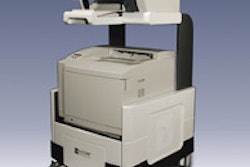
MaxxVision is a Gainesville, FL, company that's developed a handheld wand that enables users to digitize sections of film-screen mammograms
Dear AuntMinnie Member,
If you run a breast imaging service and haven't yet converted to full-field digital mammography, chances are you're intrigued by the technology, but the high prices of FFDM systems have given you pause. Enter MaxxVision, a Gainesville, FL, company that's developed a handheld wand that enables users to digitize sections of film-screen mammograms.
MaxxVision's iView device is designed to work with conventional mammograms displayed on a lightbox. The user passes the wand over a region of interest on the mammogram, and the area is digitized and sent to a display screen nearby, where the image can be processed, enlarged, or otherwise manipulated.
MaxxVision executives say the device can help breast imaging providers achieve some of the benefits of digital mammography at a fraction of the price. Learn all about the technology by clicking here, and when you're done, don't forget to check out our other AuntMinnieTV segments linked below.

![A normal mammogram confirmed by three-year radiologic follow-up illustrates reader-marked regions of interest (ROIs) during (A) unaided (round 1) and (B) artificial intelligence (AI)–assisted (round 2) reading. Each colored dot represents an ROI for recall by a human reader. Readers could mark more than one ROI per case, represented by multiple dots of the same color. During AI-assisted reading, the AI system displayed three visible prompts: two with suspicion of malignancy scores of 35% (left mediolateral oblique [L MLO] and craniocaudal [L CC]) and one with a suspicion of malignancy score of 10% (right craniocaudal [R CC]), shown as polygonal overlays. Without AI, six of 10 readers (60%) marked a false-positive ROI. With AI assistance, this fell to two of 10 (20%). R MLO = right mediolateral oblique.](https://img.auntminnie.com/mindful/smg/workspaces/default/uploads/2026/07/2026-07-14-radiology-mammogram-ai-auto-bias.H0bYO8QlWs.jpg?auto=format%2Ccompress&fit=crop&h=100&q=70&w=100)


![A normal mammogram confirmed by three-year radiologic follow-up illustrates reader-marked regions of interest (ROIs) during (A) unaided (round 1) and (B) artificial intelligence (AI)–assisted (round 2) reading. Each colored dot represents an ROI for recall by a human reader. Readers could mark more than one ROI per case, represented by multiple dots of the same color. During AI-assisted reading, the AI system displayed three visible prompts: two with suspicion of malignancy scores of 35% (left mediolateral oblique [L MLO] and craniocaudal [L CC]) and one with a suspicion of malignancy score of 10% (right craniocaudal [R CC]), shown as polygonal overlays. Without AI, six of 10 readers (60%) marked a false-positive ROI. With AI assistance, this fell to two of 10 (20%). R MLO = right mediolateral oblique.](https://img.auntminnie.com/mindful/smg/workspaces/default/uploads/2026/07/2026-07-14-radiology-mammogram-ai-auto-bias.H0bYO8QlWs.jpg?auto=format%2Ccompress&fit=crop&h=112&q=70&w=112)