An experimental PET radiotracer called Ga-68 NK224 can detect programmed death ligand 1 (PD-L1) expression across the entire body in lung cancer patients, providing a more complete picture of disease than traditional biopsies and helping predict which patients will respond to immunotherapy treatment.
- Ga-68 NK224 PET/CT reveals whole-body PD-L1 expression in non-small cell lung cancer, overcoming sampling limitations of single-site biopsies
- Among 12 patients classified as PD-L1 negative by biopsy, five had lesions exceeding the high PD-L1 threshold on PET imaging
- Immunotherapy responders showed significantly higher Ga-68 NK224 uptake (median SUVmax 5.9) compared to non-responders (1.9)
- The tracer detected substantial intratumoral and intertumoral heterogeneity across multiple tumors within individual patients
- A SUVmax cutoff of 5.6 best discriminated high PD-L1 expression for treatment decision-making
PET/CT scans with an experimental radiotracer that targets programmed death ligand 1 (PD-L1) protein on cancer cells can reveal the full burden of disease in patients with non-small cell lung cancer, according to a study published August 2026 in Radiology.
A group from the First Affiliated Hospital of Xiamen University in Xiamen, China, performed gallium-68 (Ga-68) NK224 PET/CT scans in participants with newly diagnosed, recurrent, or metastatic non-small cell lung cancer (NSCLC), with findings suggesting the approach can overcome inherent sampling limitations of single-site biopsies. Ultimately, the modality may aid personalized immunotherapy strategies for patients with multifocal metastatic disease, the authors suggested.
“Ga-68 NK224 PET/CT enabled whole-body assessment of programmed death ligand 1 heterogeneity in participants with non–small cell lung cancer and revealed lesion-level heterogeneity not captured through biopsies,” noted lead authors Liang Zhao, MD, and Hui Zhou, MD, and colleagues. “Ga-68 NK224 uptake was associated with immunotherapy response.”
Currently, PD-L1 immunohistochemical analysis performed on biopsy specimens is the standard method for evaluating patients for immunotherapy. However, increasing evidence indicates that PD-L1 expression exhibits pronounced intratumoral and intertumoral heterogeneity, which can make immunotherapy decision-making based on biopsies challenging, the researchers explained.
Alternatively, molecular imaging can provide whole-body visualization and quantitative assessment of PD-L1 expression, and to that end the group previously developed Ga-68 NK224 and found it safe and effective in a small group of patients. In this study, the researchers tested it in a larger cohort in a prospective study from December 2023 to July 2025.
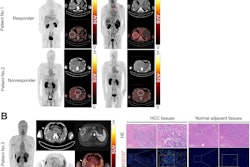
 (A) Ga-68 NK224 PET/CT maximum intensity projection image (left), axial PET/CT images (center), and axial CT images (right) in a 43-year-old female participant with lung adenocarcinoma show lesions in the right cerebellum (blue arrow), right frontal lobe (red arrow), and sternum (green arrow) with low, intermediate, and high tracer uptake, respectively. Photomicrographs (scale bar, 100 μm) with hematoxylin-eosin (H&E) staining (center bottom) and programmed death ligand 1 (PD-L1) immunohistochemical (IHC) staining (right bottom) show high PD-L1 expression in the sternal lesion (tumor proportion score ≥ 50%). RNSA
Intratumoral heterogeneity was evident, with greater Ga-68 NK224 uptake variability in whole-lesion ROIs than biopsy-plane ROIs (median SUVmax 1.0 versus 0.4; p < 0.001) and intertumoral heterogeneity within individual participants was substantial (median SUVmax coefficient of variation, 23.6%). Furthermore, among 24 lesions from immunotherapy-treated participants, responders showed greater Ga-68 NK224 uptake than non-responders (median SUVmax, 5.9 vs 1.9), the researchers reported.
“By overcoming the inherent sampling limitations of single-site biopsy, Ga-68 NK224 PET/CT provides a more comprehensive assessment of tumor immune phenotypes,” the authors wrote.
Validating quantitative uptake thresholds and determining whether PD-L1 PET-guided treatment selection improves outcomes will require larger multicenter and multiethnic trials, they concluded.
Read the full study here.



![Comparative PET/CT scan images showing [18F]FAPI and [18F]FDG imaging with MIP projections, fusion views, and CT cross-sections for medical diagnosis](https://img.auntminnie.com/mindful/smg/workspaces/default/uploads/2026/10/fapi-vs-fdg.nL6Acp6W2i.jpg?auto=format%2Ccompress&fit=crop&h=100&q=70&w=100)



![Comparative PET/CT scan images showing [18F]FAPI and [18F]FDG imaging with MIP projections, fusion views, and CT cross-sections for medical diagnosis](https://img.auntminnie.com/mindful/smg/workspaces/default/uploads/2026/10/fapi-vs-fdg.nL6Acp6W2i.jpg?auto=format%2Ccompress&dpr=2&fit=crop&h=167&q=70&w=250)


